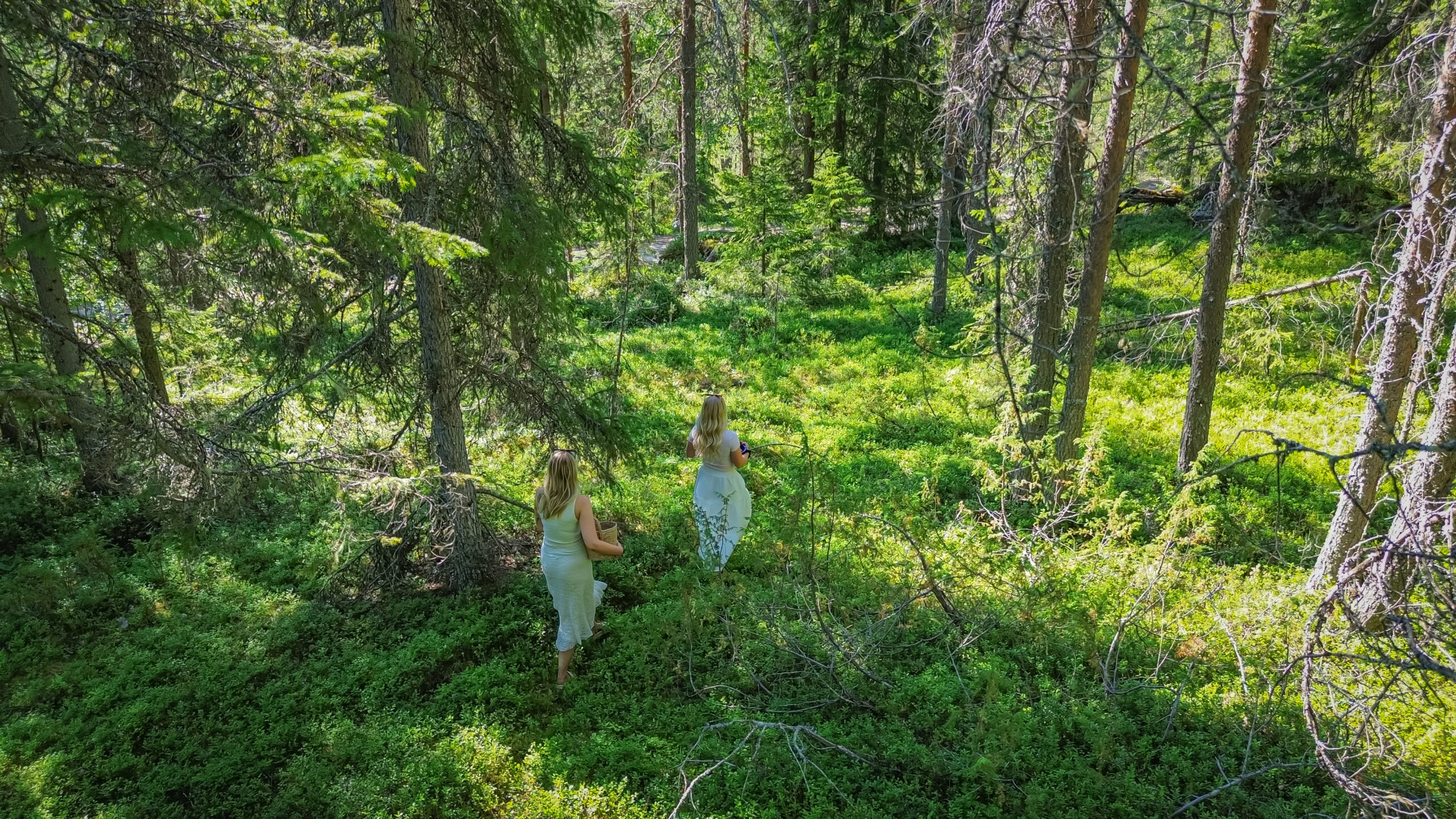
When the ruska colours arrive, our guests notice something on every forest walk: mushrooms everywhere, in every shape and colour. The question follows straight away – can you eat them?
This is our beginner’s look at Lapland mushrooms, based on what Finnish institutions publish: how much grows in the forests, which species Finns pick, which ones are deadly, and how picking works under everyman’s right. We are a tour operator, not mycologists, so everything factual here comes from the sources listed at the end.
The short answer: Finnish forests produce a huge amount of wild mushrooms, and picking them is a much-loved tradition that everyman’s right allows. But at least five Finnish species are deadly, and some poisonous mushrooms look very similar to edible ones. The rule every Finnish source repeats is simple: only pick mushrooms to eat if you can identify them as edible without any doubt. For a visitor, the safest way to enjoy mushrooms is to look, photograph and learn.
At a glance
- From: 89 €
- Experience type: Nature / Hiking tour
- Duration: 3 hours
- Difficulty: Easy
- Book in Advance: Cut off: 8 hours before start time
- Included: A Tour Guide in English (other languages available on request: (Spanish, Portuguese & Finnish. PLEASE NOTE LIMITED AVAILABILITY FOR OTHER LANGUAGES) If another language is required. Please send us an email or WhatsApp after booking.); Traditional light snacks and drinks by the campfire by the lake; Information about the Lappish forests and nature, history; Pick-ups and drop-offs are included in the price in 10 km radius from Rovaniemi city center; Photos taken with your own device; Air conditioned car
- Cancellation: Free cancellation 24 hours before the activity. We will charge a cancellation fee of 100% if booking is cancelled less than 24 hours before the activity.
- Accessibility: Not wheelchair accessible; Not stroller accessible
StayLapland · From 89 €
3 hours · Easy · Cut off: 8 hours before start time
Book Early the Activities for Winter 2026–2027 – Save 10% with code EARLY27 01.11.2026–31.03.2027 (Excludes husky & reindeer tours)
How many mushrooms grow in Finnish forests?
The numbers are large. According to thisisFINLAND, roughly two billion kilograms of mushrooms grow in Finland’s forests every year, alongside about 500 million kilograms of berries – and only a tiny proportion of this is ever gathered.
Finland’s Living Heritage wiki puts the number of fungal species growing in Finland at nearly 5,500, of which at least a couple of hundred are edible. It also notes that about 40% of Finns go mushroom picking every year, and that most Finns learned about mushrooms from their own family.
The wild mushrooms Finns pick
Arktiset Aromit, the Finnish association for natural products, presents these wild mushrooms in its guide:
- Cep (porcini)
- Orange boletes
- Slippery jack
- Northern milkcap, rufous milkcap and saffron milkcap
- Chanterelle and trumpet chanterelle
- Horn of plenty
- Sheep polypore
- Matsutake
Tastes have changed over time. The Living Heritage wiki reports that milk caps made up as much as half of what was picked in the late 1990s, while in organised trade the cep has become the number one mushroom. thisisFINLAND adds that more than 90% of ceps gathered for sale are exported, mainly to Italy.
The deadly ones every beginner should know
According to Arktiset Aromit, about 50 mushroom species in Finland are known to be toxic and at least five are deadly or dangerously poisonous. The Poison Information Centre at HUS (Helsinki University Hospital) names five of the most poisonous mushrooms in Finland:
- Destroying angel (Amanita virosa) and death cap (Amanita phalloides) – contain amatoxins, which damage the liver. Symptoms start 6–24 hours after eating.
- Funeral bell (Galerina marginata) – also contains amatoxins.
- Deadly webcap (Cortinarius rubellus) – contains orellanine, which damages the kidneys. Symptoms typically begin only after about three days.
- False morel (Gyromitra esculenta) – contains gyromitrin, which may cause liver damage. Symptoms appear within 4–12 hours.
The long delay before symptoms is exactly what makes these mushrooms so dangerous: by the time someone feels ill, the damage may already be done. HUS advises always calling the Poison Information Centre for a risk assessment if poisoning is suspected, and keeping the mushroom for later identification. In an emergency, call 112.
StayLapland · From 89 €
3 hours · Easy · Cut off: 8 hours before start time
Book Early the Activities for Winter 2026–2027 – Save 10% with code EARLY27 01.11.2026–31.03.2027 (Excludes husky & reindeer tours)
The false morel: a Finnish special case
The false morel is unusual: it is poisonous, yet Finnish official guidance still tells people how to prepare it if they do eat it. The Finnish Food Authority recommends boiling false morels twice in plenty of water (one part mushrooms to three parts water) for five minutes each time. But its 2025 report found that even after double boiling, nearly one-fifth of the original toxin remains, and that no method removes all of the gyromitrin. For visitors, the message is clear: leave false morels to the experts – or better, leave them in the forest.
Everyman’s right: where you may pick
Finland’s everyman’s right allows everyone to move freely in the countryside and to pick berries and mushrooms without a permit, as thisisFINLAND explains. According to Arktiset Aromit, you may pick even on privately owned land, but not in private yards, and you must not cause disturbance or damage to the landowner.
Protected areas can have their own rules, so check the local signs before you pick anything in a national park or nature reserve.
How Finns pick and handle mushrooms
Arktiset Aromit gives practical advice that is useful even if you only want to understand what you see Finnish pickers doing:
- Pick the whole mushroom, twisting it carefully out of the ground rather than cutting it. The shape of the base is an important feature for identification.
- Use an airy basket, never a plastic bag or bucket, which make mushrooms spoil quickly.
- Avoid picking in rain or when the mushrooms are wet, and choose young specimens in good condition.
- Clean and process mushrooms straight away, ideally already in the forest.
- Avoid white mushrooms altogether if you are not an expert, and be careful with mushrooms growing on tree stumps.
How this shows up on our tours
We do not run a mushroom-picking tour, and our guides do not identify mushrooms for eating. What we do offer is time in the autumn forest with someone who knows it well.
On Hidden Trails of Kuoksa (from 89 €, 3 hours) a local guide walks with you through the peaceful forests of our Kuoksa wilderness park, sharing insights into the area’s history, wildlife and way of life in Lapland. We pause by a campfire to taste local snacks and drinks. If you spot mushrooms along the way, take photos and ask your guide about the forest – just please do not eat anything you find.
If you would rather fill a basket, our Wild Berry Hunt (from 89 €, 3 hours) takes you into our private forests to forage for seasonal berries; the product page lists September as the lingonberry season. You can find more of our autumn and nature tours on the nature and culture tours page, and read about another Lapland autumn tradition in Reindeer roundup in Finland: the autumn erotus, explained.
Frequently asked questions
Can I pick mushrooms in Lapland as a tourist?
Everyman’s right lets everyone pick mushrooms without a permit, also on privately owned land, but not in private yards. Protected areas can have their own rules. Only eat mushrooms you can identify as edible without any doubt.
Are there deadly mushrooms in Finland?
Yes. HUS Poison Information Centre names destroying angel, death cap, funeral bell, deadly webcap and false morel among the most poisonous mushrooms in Finland.
How many poisonous mushrooms grow in Finland?
According to Arktiset Aromit, about 50 species are known to be toxic and at least five are deadly or dangerously poisonous.
Is the false morel safe after boiling?
Not completely. The Finnish Food Authority found that nearly one-fifth of the toxin remains even after the recommended double boiling.
Does StayLapland run mushroom-picking tours?
No. Our Hidden Trails of Kuoksa forest walk and our Wild Berry Hunt take you into the forest, but our guides do not identify mushrooms for eating.
What should I do if I think I have eaten a poisonous mushroom?
HUS advises calling the Poison Information Centre for a risk assessment and keeping the mushroom for identification. In an emergency, call 112.
Ready to book?
StayLapland · From 89 €
3 hours · Easy · Cut off: 8 hours before start time
Book Early the Activities for Winter 2026–2027 – Save 10% with code EARLY27 01.11.2026–31.03.2027 (Excludes husky & reindeer tours)
Questions before booking? Email booking@staylapland.com or WhatsApp +358 40 128 7846.
You may also like
- Wild Berry Hunt — from 89 €, 3 hours
- Fishing Experience at Kuoksa Private Lake — from 89 €, 4 hours
Sources
- thisisFINLAND (Ministry for Foreign Affairs of Finland): Treasures of Finland’s boreal forests
- HUS Poison Information Centre: The most poisonous mushrooms in Finland
- Finnish Food Authority: Nearly one-fifth of toxin remains in false morels despite boiling recommendation (2025)
- Arktiset Aromit: Poisonous mushrooms
- Arktiset Aromit: Harvesting mushrooms
- Arktiset Aromit: Wild mushrooms
- Living Heritage wiki (Finnish Heritage Agency): Picking mushrooms