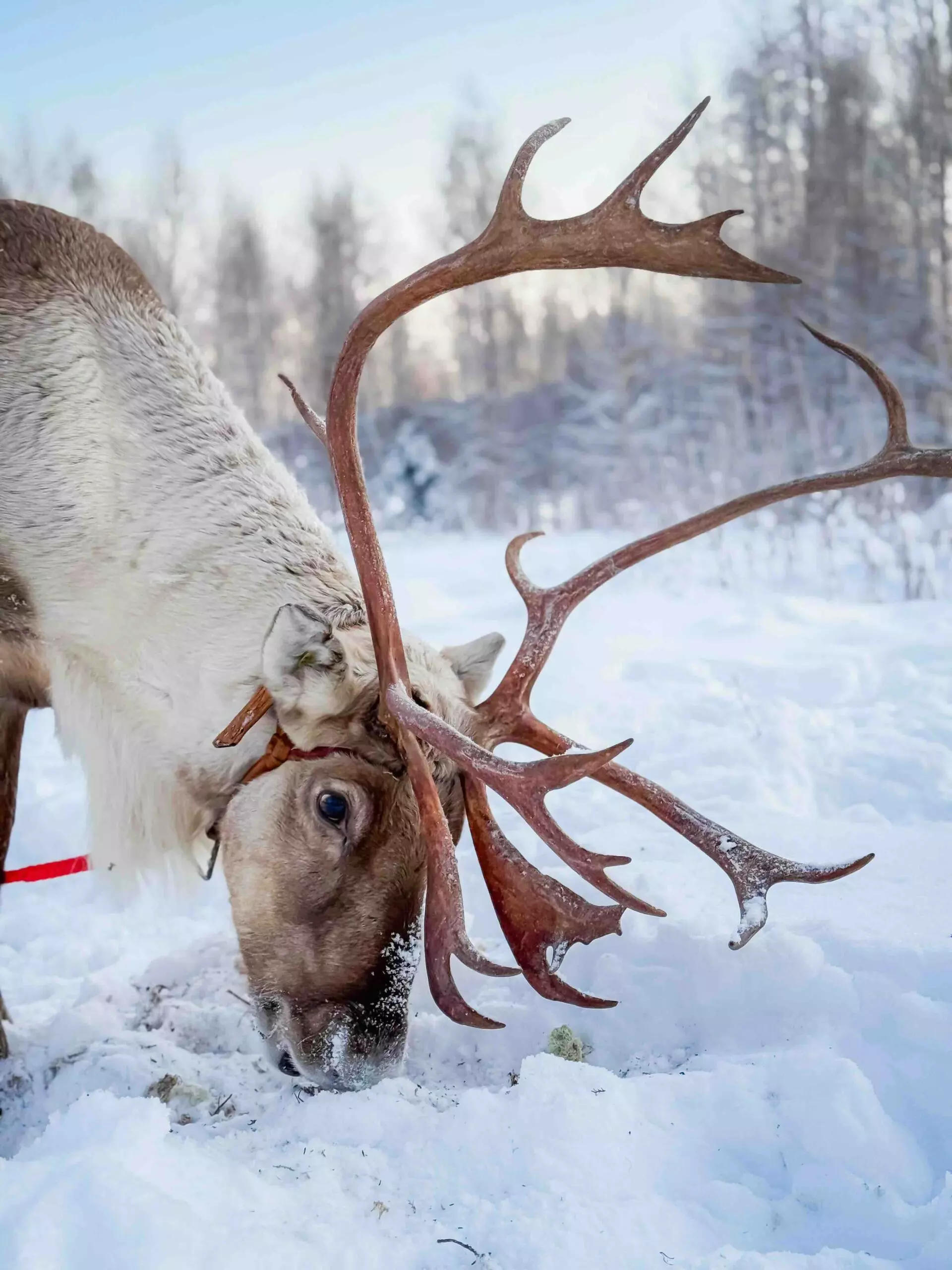
One of the questions our guests ask most often at the reindeer farm in winter is a simple one: why do some of the reindeer have big antlers and others none at all? The answer surprises many people. In reindeer, both males and females grow antlers, and in the middle of winter it is very often the females who are still carrying theirs.
In this article we explain how reindeer antlers grow, what the soft “velvet” stage is, when males and females drop their antlers, and why the females keep theirs through the hardest months of the year. The biology comes from the Finnish Reindeer Herders’ Association (Paliskuntain yhdistys) and from our own herders’ knowledge, and at the end we show how this shows up on our reindeer tours in Rovaniemi.
In short: female reindeer keep their antlers in winter because they need them to find and defend food. Pregnant females use their antlers to claim and hold on to the feeding holes they dig in the snow, and according to the Reindeer Herders’ Association they are the only reindeer with antlers during the food-critical period of April and May. Males drop their antlers after the autumn rut, while females drop theirs a week or two after their calves are born in spring.
At a glance
- From: 159 €
- Experience type: Reindeer tour
- Duration: 3 hours
- Difficulty: Very easy
- Book in Advance: Cut off: 12 hours before start time
- Included: 2-3 km reindeer safari in the forest of Lapland; Information about the life of reindeer, reindeer farm and reindeer herding in general; A Tour Guide in English (other languages available on request: (Spanish, Portuguese, French, Italian, German & Finnish. PLEASE NOTE LIMITED AVAILABILITY FOR OTHER LANGUAGES) If another language is required. Please send us an email or WhatsApp after booking.); Winter clothing (Adult & Child size), overalls, boots, gloves, socks; Cookies and juice; Photos taken with your own device; Pick-ups are included in the price within a 10 km radius of Rovaniemi city centre; Between 1 December and 10 January, drop-offs are included only to selected locations: Postmaster Hotel, Rovaniemi City Centre, Ollerovaara area and Santa Claus Village; Air conditioned car
- Cancellation: Free cancellation 24 hours before the activity. We will charge a cancellation fee of 100% if booking is cancelled less than 24 hours before the activity.
- Accessibility: Not wheelchair accessible; Not stroller accessible
StayLapland · From 159 €
3 hours · Very easy · Cut off: 12 hours before start time
#bokun_7601c828_ee32_c209_6f24_5e0ec940075d { display: inline-block; padding: 10px 20px; background: #408C3D; border-radius: 5px; box-shadow: none; font-weight: 600; font-size: 16px; text-decoration: none; text-align: center; color: #FFFFFF; border:none; cursor: pointer; transition: background .2s ease; } #bokun_7601c828_ee32_c209_6f24_5e0ec940075d:hover{ background: #285726; } #bokun_7601c828_ee32_c209_6f24_5e0ec940075d:active{ background: #30682e; }The only deer where females grow antlers too
Reindeer are the only species in which the females also grow antlers. In every other deer, antlers belong to the males alone. As the Reindeer Herders’ Association puts it, “both female and male reindeer grow solid bone antlers that drop once a year and grow again”.
Antlers are made of bone, they grow fresh every year and they are shed every year. Even calves start early: their antlers begin to grow in their first weeks of life, and by autumn a calf’s antlers are roughly 20 cm long. Young antlers look like two simple sticks rather than the branched crowns of older animals.
Antlers also differ between the two types of reindeer: mountain reindeer tend to have lighter-coloured and broader antlers, while forest reindeer have darker and narrower ones. In the herd, antlers matter socially as well, because they affect a reindeer’s status.
How antlers grow: the fastest-growing antlers in the world
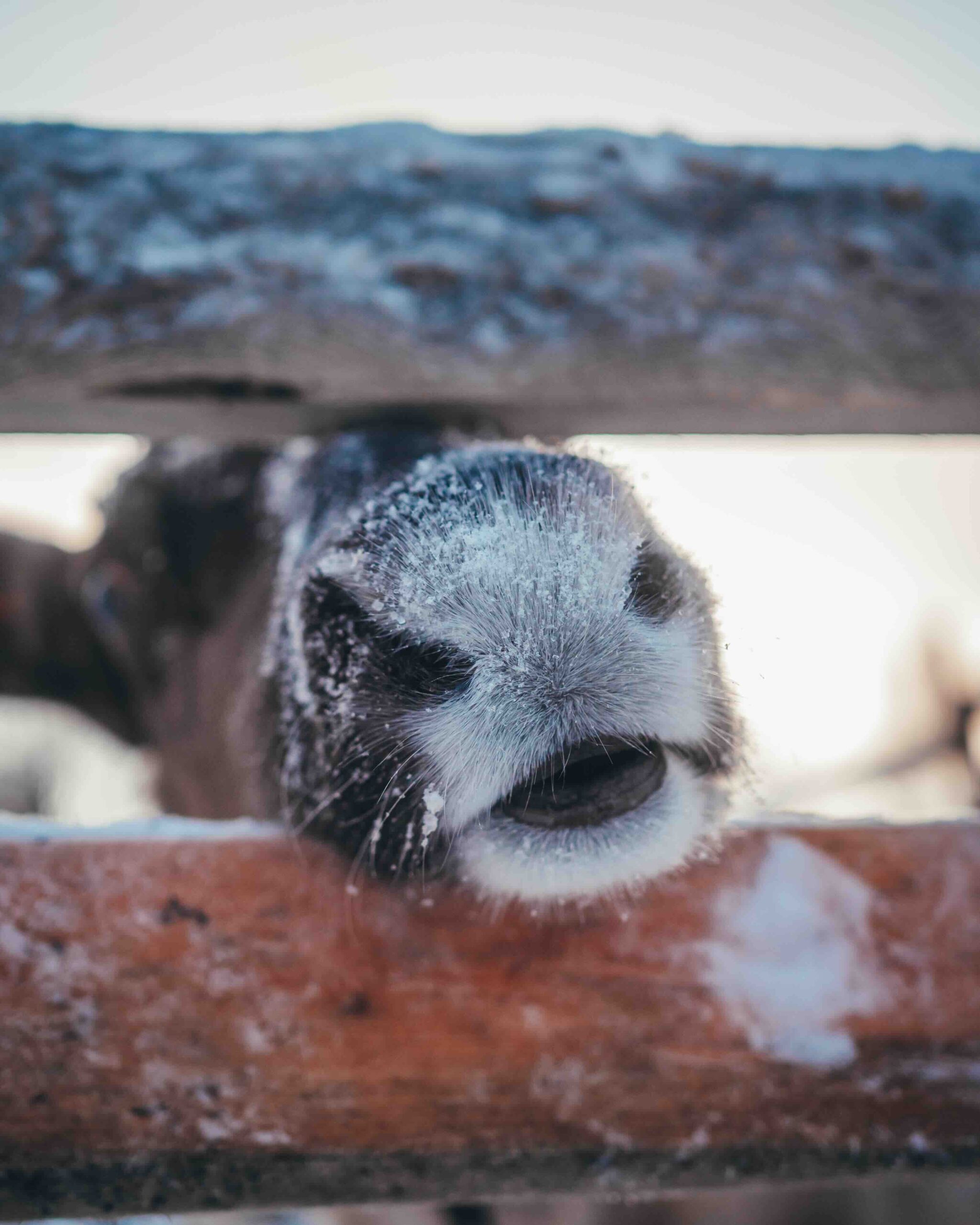
Reindeer antler is the fastest-growing antler in the world: it can grow around two centimetres per day. That growth happens during the short, bright northern summer, when the herds are out in the forest building up reserves for winter.
While they grow, the antlers are soft and covered by skin. This soft, skin-covered stage is what people usually call “velvet”, because the covering looks and feels like fine fur. Later in the autumn the antlers harden, and the reindeer rub them against something hard, such as trees, to peel the skin off. What is left is the hard, bare bone antler you see on a reindeer in winter.
So if you see a reindeer in late summer with fuzzy, rounded antlers, and the same animal in October with clean, pale bone antlers and scraped trees nearby, you have seen the whole process from velvet to hard antler.
Autumn: the rut, and why the males drop their antlers
Autumn is mating season. The Reindeer Herders’ Association says the rut starts at the end of September and lasts until October–November. This is when male antlers are at their biggest and strongest. The males gather harems, guard them jealously and clash antlers with rival males to strengthen and defend their position. The biggest, strongest and most energetic males win.
Once the rut is over, the males have done what their antlers were for. They drop them and start growing new ones for the next year. That is why many adult males have no antlers, or only small new ones, during the winter months.
A practical note if you are hiking in Lapland in autumn: rutting males can be aggressive. The association’s advice is to go around reindeer at a safe distance, never to put yourself between a male and his females, to make a little noise so you do not surprise them, and to take photos from afar.
StayLapland · From 159 €
3,5 hours · Easy · Cut off: 8 hours before start time
#bokun_3f22bede_373f_dc6f_6e8d_5392c06f7076 { display: inline-block; padding: 10px 20px; background: #408C3D; border-radius: 5px; box-shadow: none; font-weight: 600; font-size: 16px; text-decoration: none; text-align: center; color: #FFFFFF; border:none; cursor: pointer; transition: background .2s ease; } #bokun_3f22bede_373f_dc6f_6e8d_5392c06f7076:hover{ background: #285726; } #bokun_3f22bede_373f_dc6f_6e8d_5392c06f7076:active{ background: #30682e; }Winter: why the females keep their antlers
For reindeer, winter is about food. Their favourite winter food is lichen, and it lies under the snow. Reindeer find it with their excellent sense of smell and dig it out with their hooves, which are adapted to walking in thick snow and digging. The Reindeer Herders’ Association quotes the researcher Timo Helle: a reindeer “digs food seven months in a year, at least eight hours per day”. The digging holes have their own Finnish word, kiekerö. You can read more about this in our article on how reindeer dig for lichen under the snow.
A good feeding hole is valuable, and other reindeer will try to take it. This is where the female’s antlers matter. Most females are pregnant through the winter while still caring for the previous year’s calf. With their antlers they can defend or claim digging holes, chase away bigger reindeer, or wait for others to dig and then take over the spot. With the males’ antlers gone after the rut, a pregnant female with antlers can hold her ground against an animal that may be much larger than she is.
It is a hard season. According to the association, reindeer lose around 10 to 20 percent of the weight they gained in autumn during the winter, and in harsh winters even 40 percent. A female that can keep her feeding hole feeds herself, her unborn calf and, through her, next year’s herd. In the words of the association, the females are the only ones with antlers in the food-critical period of April and May.

Spring: calves arrive and the females drop their antlers
The reindeer year begins with the calves. Calving starts in May, as the old Finnish saying “calf in the snow on the First of May” suggests, and can continue until the end of June. Newborn calves weigh just 4–6 kg, and their antlers start to grow in their first weeks.
A week or two after calving, the mothers drop their antlers. By then the snow is melting, food is easier to reach and the antlers have done their job. A few weeks later, both males and females are growing new antlers again, and the cycle starts over.
Does it hurt when reindeer shed their antlers?
Guests often worry about this. Antlers are shed as part of the natural yearly cycle, and new ones grow in their place. We have written about this question separately in Does it hurt when reindeer shed antlers?.
For the reindeer themselves, antlers are also a tool for everyday contact. One of our own working reindeer at Kuoksa, Markku, has a habit of “cuddling” people by gently rubbing his antlers against them, as we describe on the Kuoksa Reindeer Stories page.
How this shows up on our tours
Our working reindeer live at Kuoksa Reindeer Stories in Kuoksajärvi, while most of the herd spends the year out in the forest. Reindeer herding runs in the family of our founder Jouni Savukoski, and our guides are happy to explain the reindeer year, antlers included, while you are with the animals. You can read more on our reindeer information page and in our article about reindeer safaris in Rovaniemi.
On the Kuoksa Reindeer Adventure (from 159 €, 3 hours) you ride a 2–3 km reindeer safari through the Lapland forest and hear about the life of reindeer, the reindeer farm and reindeer herding in general. Warm winter clothing, cookies and juice and pick-up within 10 km of Rovaniemi city centre are included. If the weather does not allow a sleigh ride, the tour is arranged as a reindeer walk instead.
If you would like to combine reindeer with something else, Ice Fishing with Reindeer (from 159 €, 3.5 hours) adds ice fishing and snacks by the campfire, and the Northern Lights Tour Reindeer Safari (from 179 €, 3.5 hours) takes you into the forest in the evening, looking out for the aurora. All our reindeer experiences are on the reindeer activities page. When you are with the reindeer, ask your guide about the antlers of the animals you meet: every reindeer is at its own point in the yearly cycle.
Frequently asked questions
Do female reindeer have antlers?
Yes. Reindeer are the only deer species in which the females also grow antlers. Both males and females grow new bone antlers every year and shed them once a year.
Why do female reindeer keep their antlers in winter?
Pregnant females use their antlers to claim and defend the feeding holes they dig in the snow for lichen. According to the Reindeer Herders’ Association, they are the only reindeer with antlers in the food-critical period of April and May.
When do male reindeer lose their antlers?
Males drop their antlers after the autumn rut, which starts at the end of September and lasts until October–November, and then start growing new ones.
When do female reindeer lose their antlers?
Females drop their antlers a week or two after their calves are born. Calving starts in May and can continue until the end of June.
What is reindeer antler velvet?
While antlers grow in summer they are soft and covered by skin, often called velvet. In autumn the antlers harden and reindeer rub them against trees to peel the skin off.
How fast do reindeer antlers grow?
Reindeer antler is the fastest-growing antler in the world and can grow around two centimetres per day.
Can I see reindeer antlers on a StayLapland tour?
Yes. On our reindeer tours, such as the Kuoksa Reindeer Adventure, you meet our working reindeer and our guides tell you about the life of reindeer and reindeer herding.
Ready to book?
StayLapland · From 159 €
3 hours · Very easy · Cut off: 12 hours before start time
#bokun_1b00abf6_8e0d_be87_b488_e3ed77a9a6ee { display: inline-block; padding: 10px 20px; background: #408C3D; border-radius: 5px; box-shadow: none; font-weight: 600; font-size: 16px; text-decoration: none; text-align: center; color: #FFFFFF; border:none; cursor: pointer; transition: background .2s ease; } #bokun_1b00abf6_8e0d_be87_b488_e3ed77a9a6ee:hover{ background: #285726; } #bokun_1b00abf6_8e0d_be87_b488_e3ed77a9a6ee:active{ background: #30682e; } #bokun_e81aebdc_261a_a1e0_cc89_5777e833acf2 { display: inline-block; padding: 10px 20px; background: #408C3D; border-radius: 5px; box-shadow: none; font-weight: 600; font-size: 16px; text-decoration: none; text-align: center; color: #FFFFFF; border:none; cursor: pointer; transition: background .2s ease; } #bokun_e81aebdc_261a_a1e0_cc89_5777e833acf2:hover{ background: #285726; } #bokun_e81aebdc_261a_a1e0_cc89_5777e833acf2:active{ background: #30682e; }Questions before you book? Email booking@staylapland.com or WhatsApp +358 40 128 7846 and our team will help.
You may also like
- Ice Fishing with Reindeer — from 159 €, 3,5 hours
- Northern Lights Tour Reindeer Safari — from 179 €, 3,5 hours
Sources
- Reindeer Herders’ Association: Reindeer
- Reindeer Herders’ Association: A year of a reindeer
- Reindeer Herders’ Association: Reindeer and summer
- Reindeer Herders’ Association: Rutting season – be careful!
- Reindeer Herders’ Association: Reindeer and winter
- Reindeer Herders’ Association: Reindeer and spring