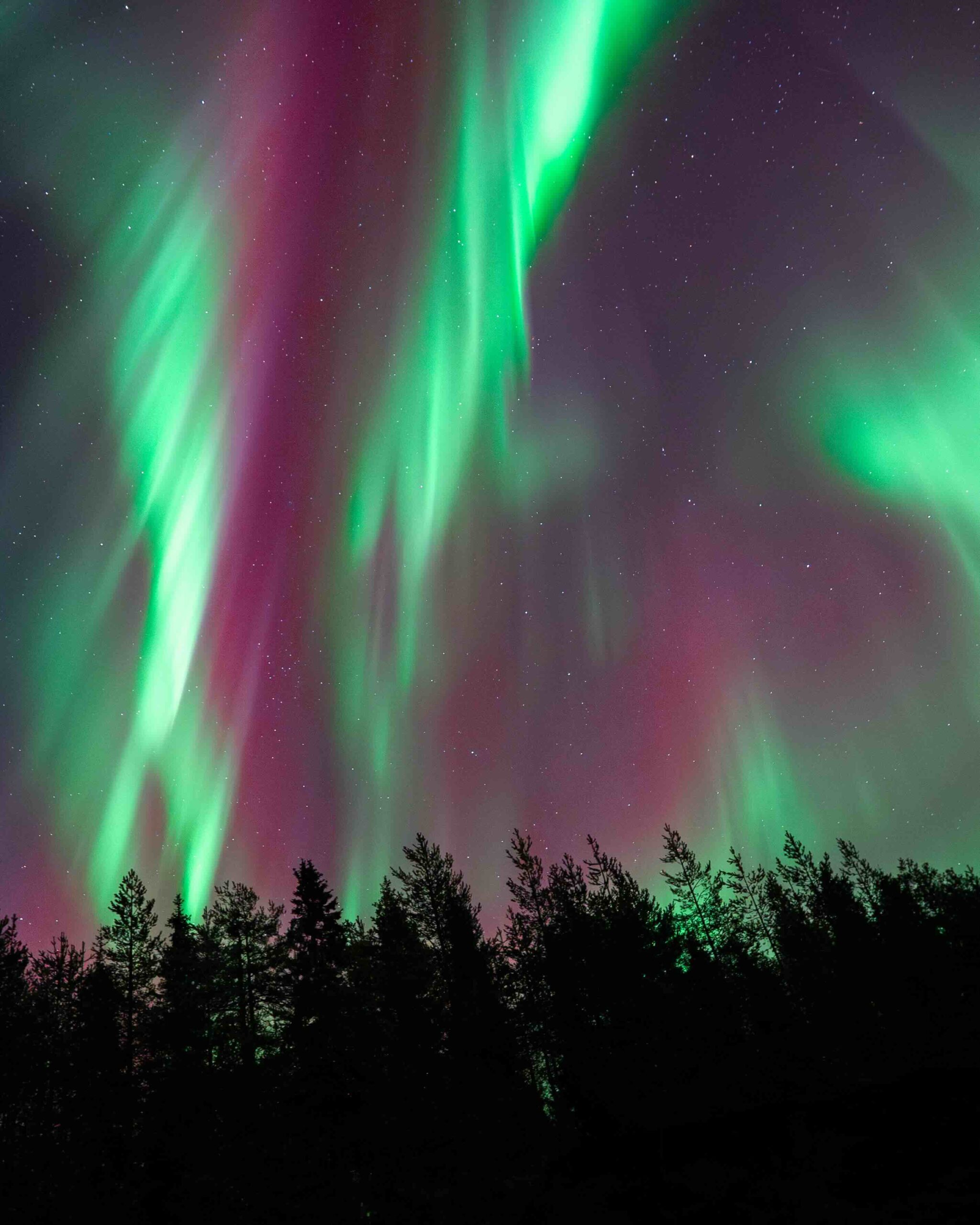
The autumn equinox has just passed, and it is a good moment to answer a question our guides hear on almost every early-season Northern Lights evening: is it true that the auroras are stronger around the equinoxes? The short answer is yes – on average. The longer answer is one of the nicest pieces of space physics we know, and it has a name: the Russell–McPherron effect.
We are StayLapland, and we take guests out under the Rovaniemi sky every night of the aurora season. In this article we explain what the scientists say, what “on average” really means for your own night, and how this shows up on our tours.
The short answer: the Finnish Meteorological Institute (FMI) explains that around the spring and autumn equinoxes the Earth’s position in the solar wind is most favourable for energy from the solar wind to pass efficiently into the Earth’s magnetosphere. As a result, magnetic storms – which drive the strongest auroras – occur on average more often in autumn and spring than in summer and winter. That is a statistical pattern, not a promise for any single night: clouds, the Sun’s activity and plain luck still decide what you see.
At a glance
- From: 99 €
- Experience type: Northern Lights tour / activity
- Duration: 3 hours
- Difficulty: Very easy
- Book in Advance: Cut off: 3 hours before start time
- Included: A Tour Guide in English (other languages available on request: (Spanish, Portuguese, French, Italian, German & Finnish. PLEASE NOTE LIMITED AVAILABILITY FOR OTHER LANGUAGES) If another language is required. Please send us an email or WhatsApp after booking.); Winter clothing (Adult & Child size), overalls, boots, gloves, socks; Local Snack & Drinks by the campfire; Information about the Northern Lights; Pick-ups and drop-offs are included in the price in 10 km radius from Rovaniemi city center; Photos taken with your own device; Air conditioned car
- Cancellation: Free cancellation 24 hours before the activity. We will charge a cancellation fee of 100% if booking is cancelled less than 24 hours before the activity.
- Accessibility: Not wheelchair accessible; Not stroller accessible
StayLapland · From 99 €
Northern Lights Tour At The Campfire
3 hours · Very easy · Cut off: 3 hours before start time
Book Early the Activities for Winter 2026–2027 – Save 10% with code EARLY27 01.11.2026–31.03.2027 (Excludes husky & reindeer tours)
What an aurora is, in one paragraph
NOAA’s Space Weather Prediction Center describes the Northern Lights as the result of electrons colliding with the upper reaches of the Earth’s atmosphere. The Earth’s magnetic field guides those electrons so that the aurora forms two ovals, roughly centred on the magnetic poles. During major geomagnetic storms these ovals expand away from the poles – which is why a strong storm can bring auroras much further south than usual. Lapland sits under the northern oval, which is why the Northern Lights are part of ordinary winter life here. FMI lists the typical colours as green, red and violet.
For the full chain of events, from the Sun to the sky above Kuoksa, see our article on how auroras are formed.
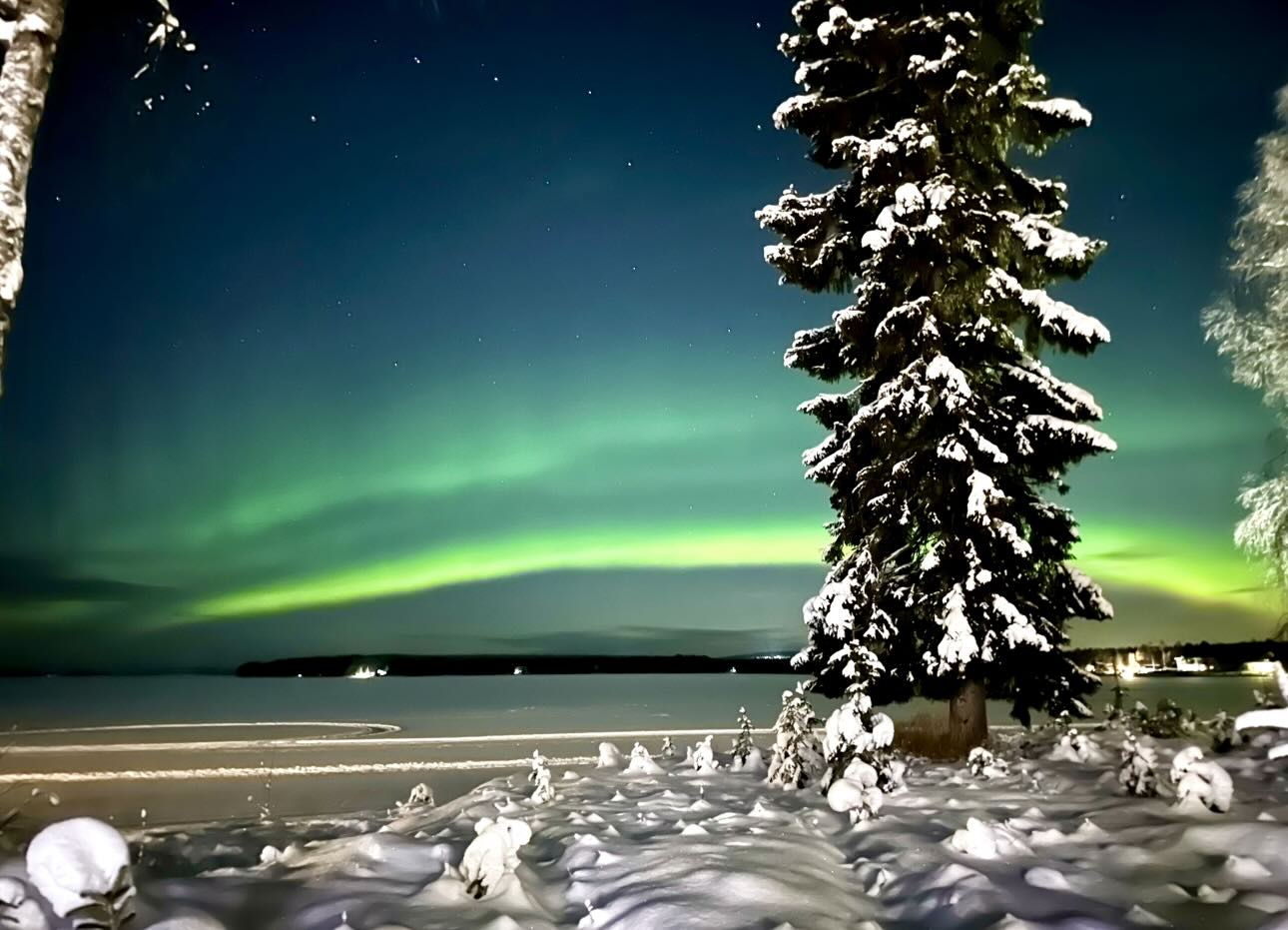
Why the equinoxes matter: what FMI says
The equinoxes fall around 20 March and 22–23 September, when day and night are roughly the same length everywhere on Earth. In its aurora questions and answers, FMI makes three points that are worth knowing:
- Around the spring and autumn equinoxes, the Earth’s position in the solar wind is at its most favourable for solar wind energy to transfer efficiently into the magnetosphere.
- For that reason, magnetic storms occur on average more often in autumn and spring than in summer and winter.
- FMI names March as a recommended time for waiting for the auroras.
Scientists call this the semiannual variation of geomagnetic activity – “semiannual” because the pattern peaks twice a year.
The Russell–McPherron effect, explained simply
The best-known explanation comes from a 1973 paper by Christopher Russell and Robert McPherron in the Journal of Geophysical Research, titled “Semiannual variation of geomagnetic activity”. Their idea, as summarised in the paper’s abstract, is that the semiannual variation may be caused by a semiannual variation in the effective southward component of the interplanetary magnetic field.
Here is what that means in plain language. The solar wind carries the Sun’s magnetic field out through the solar system. When that field points southward relative to the Earth’s own magnetic field, the two connect easily and energy pours into the magnetosphere – that is when auroras flare up. The Sun’s field is organised around the Sun’s geometry, while the Earth’s magnetic field is tilted relative to it, and that tilt changes through the year and through the day. Around the equinoxes the geometry lines up so that, on average, more of the Sun’s field ends up pointing “south” from the Earth’s point of view.
Nothing about the Sun itself changes at the equinox. What changes is the angle at which the Earth meets the solar wind – which is exactly the point FMI makes.
StayLapland · From 109 €
Northern Lights Tour in Atmospheric Cottage
3 hours · Very easy · Cut off: 3 hours before start time
Book Early the Activities for Winter 2026–2027 – Save 10% with code EARLY27 01.11.2026–31.03.2027 (Excludes husky & reindeer tours)
It is not the only factor
Later research built on Russell and McPherron’s work rather than replacing it. A 1996 study by Crooker and colleagues, using data from NASA’s Wind spacecraft, found that the polarity effect of Russell and McPherron combined with high-speed solar wind streams to create a recurring pattern of sustained geomagnetic activity. A 2010 paper by McPherron, Baker and Crooker, listed in NASA’s Technical Reports Server, concluded that the Russell–McPherron effect strongly controls whether a given high-speed stream is geoeffective – that is, whether it actually disturbs the Earth’s magnetic field.
So the equinox is best thought of as a helping hand: it makes the Earth more receptive, but the Sun still has to deliver the solar wind, and the long 11-year solar cycle still sets the overall level of activity.
What “statistically strong” means for your night
Averages are built from many years of nights. On any one evening, three things decide what you see: whether the Sun is sending anything our way, whether the sky above you is clear, and whether it is properly dark.
- Clear skies: FMI notes that in Finland auroras are seen most often in northern Lapland around the latitude of Kilpisjärvi, where on clear dark nights they are observed on average on three nights out of four. Further south the figure is lower, and cloud is always the biggest spoiler.
- Time of night: FMI explains that activity peaks around 23:30, the magnetic midnight in Finland – although auroras can appear at any time of the dark evening.
- Darkness: NOAA points out that in summer the midnight sun prevents auroral observations at auroral latitudes. By the autumn equinox the dark nights are back, which is why our season starts when it does.
How this shows up on our tours
Our season runs through both equinox periods: the tour page for our Northern Lights Tour At The Campfire notes that the Northern Lights are visible in Lapland for over eight months, from early August until late April. For you, the equinox effect is simply one more reason why September–October and March evenings are worth planning around.
On the campfire tour we pick you up in Rovaniemi and drive about 30 minutes to Kuoksa Wilderness Park, our private land away from the city lights. You wait by the fire in our teepee with a local snack and a hot drink while your guide explains what is happening above you. The tour lasts 3 hours and starts from 99 €. We cannot guarantee a sighting – the Northern Lights depend on weather and solar activity – but a dark, quiet spot and a patient guide give you a real chance.
If you would rather wait indoors in the warmth between looks at the sky, the Northern Lights Tour in Atmospheric Cottage takes you to a traditional Finnish cottage of more than 100 years by a lake, about 20 minutes from the city. And if clear skies are the whole point for you, our guaranteed hunting tours – the bus tour and the small-group tour – follow the forecasts to find the clearest sky of the night, with professional photos included and a 100% refund if we don’t capture the Northern Lights. For more on locations, read where to see the Northern Lights.
A note on expectations
One honest point our guides always make: the Northern Lights look stronger on camera than to the naked eye. A faint grey-green arc overhead can turn vivid green on a phone screen. That is not a trick – cameras simply collect more light than our eyes do in the dark. Around the equinoxes, when storms are more frequent, the chance of a display bright enough to see its colour clearly is, on average, a little better. Dress warmly, give your eyes time to adjust away from torches and phone screens, and look north first.
Frequently asked questions
Are auroras really stronger at the equinoxes?
On average, yes. FMI explains that magnetic storms occur more often in autumn and spring than in summer and winter, because the Earth’s position in the solar wind is most favourable around the equinoxes.
What is the Russell–McPherron effect?
An explanation published by Russell and McPherron in 1973: the effective southward component of the interplanetary magnetic field varies through the year, and is larger on average around the equinoxes, which makes geomagnetic activity stronger then.
Does the equinox guarantee Northern Lights?
No. It raises the average, but each night still depends on solar activity, clear skies and darkness.
When is the Northern Lights season in Lapland?
According to our tour page, the Northern Lights are visible in Lapland for over eight months, from early August until late April.
What time of night is best?
FMI says aurora activity in Finland peaks around 23:30, magnetic midnight, but auroras can appear throughout the dark evening. Our campfire tour starts at 20:00 and lasts 3 hours.
Which StayLapland tour gives the best chance?
Our guaranteed hunting tours follow the forecasts to the clearest sky and refund 100% if we don’t capture the Northern Lights. The campfire and cottage tours stay in one beautiful, dark place and cannot guarantee a sighting.
Ready to book?
StayLapland · From 99 €
Northern Lights Tour At The Campfire
3 hours · Very easy · Cut off: 3 hours before start time
Book Early the Activities for Winter 2026–2027 – Save 10% with code EARLY27 01.11.2026–31.03.2027 (Excludes husky & reindeer tours)
Questions about the aurora season? Email booking@staylapland.com or WhatsApp +358 40 128 7846.
You may also like
- Northern Lights Tour in Atmospheric Cottage — from 109 €, 3 hours
- Professional Guaranteed Northern Lights Hunting Tour from Rovaniemi by Bus — from 109 €, Total duration of tour is usually 4-5 hours depends on conditions of the day
- Professional Small Group Northern Lights Hunting Tour from Rovaniemi – Guaranteed — from 199 €, Total duration of tour is usually 4-10 hours depends on conditions of the day
Sources
- Finnish Meteorological Institute – Revontulet: kysymyksiä ja vastauksia (aurora FAQ)
- Finnish Meteorological Institute – Missä ja milloin revontulia havaitaan?
- NOAA Space Weather Prediction Center – Aurora
- Russell & McPherron (1973), Semiannual variation of geomagnetic activity, J. Geophys. Res. – NASA ADS
- Crooker et al. (1996), A two-stream, four-sector, recurrence pattern – NASA Wind MFI abstracts
- McPherron, Baker & Crooker (2010), Role of the Russell-McPherron Effect in the Acceleration of Relativistic Electrons – NASA NTRS