When guests watch a husky team being hitched for the first time, the question comes almost immediately: does it matter which dog goes where? It does. A sled dog team is organised into positions, and each one asks something different of the dog in it.
Mushers usually describe four positions, from the front of the team to the sled: lead dogs, swing dogs, team dogs and wheel dogs. Below we explain what each position does, using the definitions published by mushing and educational institutions, and then how this shows up when you drive a team yourself on one of our husky rides.
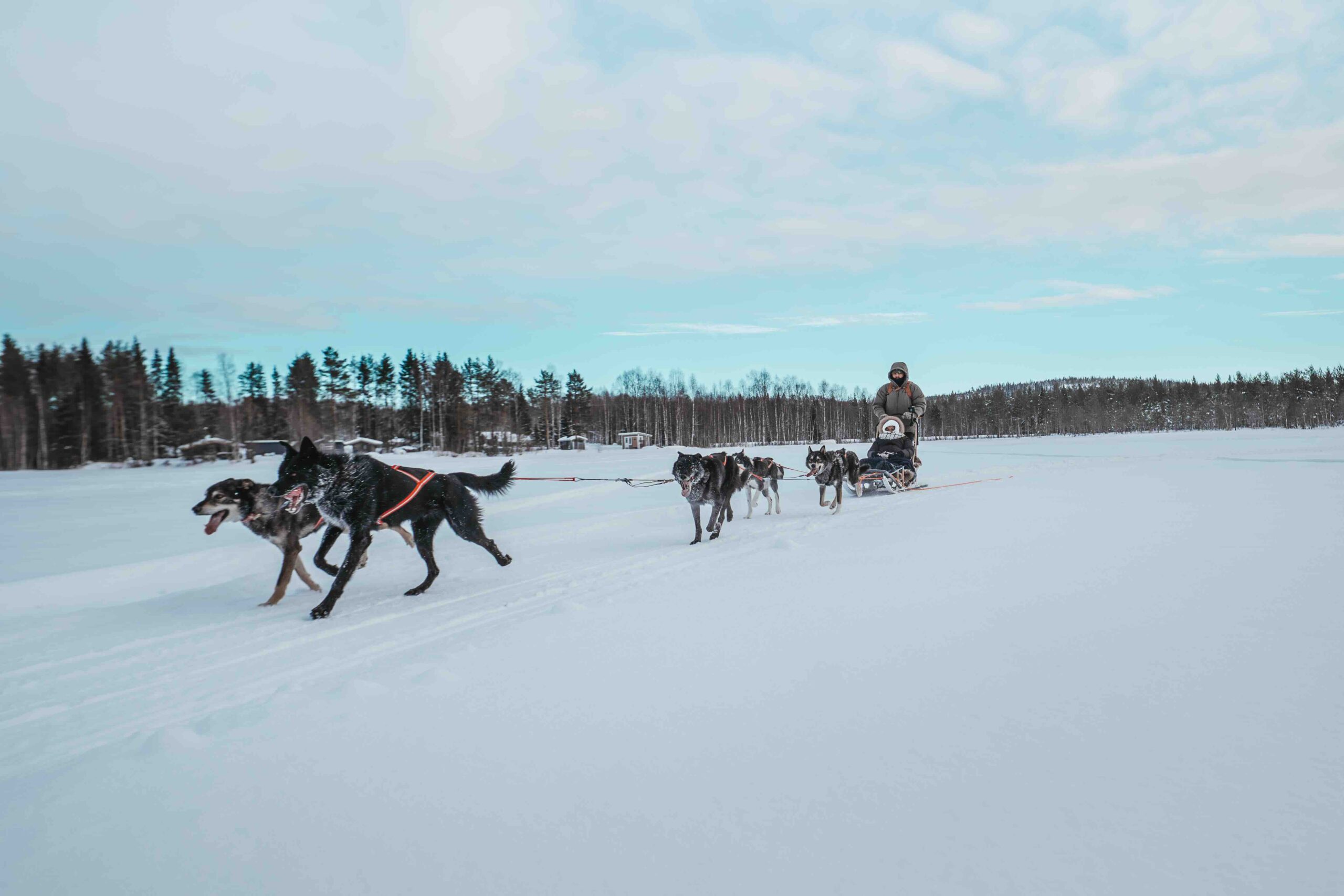
The four classic sled dog team positions are: lead dogs at the front, who take the musher’s voice commands and set the pace; swing dogs (also called point dogs) right behind them, who help swing the team around corners; team dogs in the middle, who provide most of the pulling power; and wheel dogs, harnessed closest to the sled, who are generally the strongest and take the most strain.
At a glance
- From: 189 €
- Experience type: Husky tour
- Duration: 4 hours
- Difficulty: Easy
- Book in Advance: Cut off: 12 hours before start time
- Included: A Husky Ride 5 Km (Self-driving); Detailed instructions on how to safely mush the Huskies; Information about Huskies; Photos taken with your own device; A Tour Guide in English (other languages available on request: (Spanish, Portuguese, French, Italian, German & Finnish. PLEASE NOTE LIMITED AVAILABILITY FOR OTHER LANGUAGES) If another language is required. Please send us an email or WhatsApp after booking.); Winter clothing (Adult & Child size), overalls, boots & gloves; Cookies and juice; Pick-ups are included in the price within a 10 km radius of Rovaniemi city centre; Between 1 December and 10 January, drop-offs are included only to selected locations: Postmaster Hotel, Rovaniemi City Centre, Ollerovaara area and Santa Claus Village
- Cancellation: Free cancellation 24 hours before the activity. We will charge a cancellation fee of 100% if booking is cancelled less than 24 hours before the activity.
- Accessibility: Not wheelchair accessible; Not stroller accessible
StayLapland · From 189 €
4 hours · Easy · Cut off: 12 hours before start time
#bokun_582265de_bbbc_9762_09f0_eefaa2e50fd9 { display: inline-block; padding: 10px 20px; background: #408C3D; border-radius: 5px; box-shadow: none; font-weight: 600; font-size: 16px; text-decoration: none; text-align: center; color: #FFFFFF; border:none; cursor: pointer; transition: background .2s ease; } #bokun_582265de_bbbc_9762_09f0_eefaa2e50fd9:hover{ background: #285726; } #bokun_582265de_bbbc_9762_09f0_eefaa2e50fd9:active{ background: #30682e; }How a team is hitched
All the dogs in a team are connected to one central line. The University of Alaska Fairbanks’ Project Jukebox glossary defines the gangline as the line that connects the pulling dogs to the sled, running down the middle of the team. Each dog is attached to it by a tugline, which runs from the back of the harness to the gangline and is the line that the individual dog actually pulls on. A short neckline connects the dog’s collar loosely to the gangline, keeping the dog in line.
Because the dogs pull from the back of the harness, the whole team works like one long engine. That is also why the order of the dogs matters: every position sits at a different point along that line and meets different forces.

Lead dogs: the ones at the front
Lead dogs run at the very front, and their job is the most mental one. The Iditarod describes them as usually fast runners who set the pace and have to listen to and follow the musher’s commands. They read the trail, sometimes make quick decisions, go around danger or stop the team.
A team can have a single leader or two dogs running side by side, which the UAF glossary calls single lead and double lead. A US National Park Service lesson plan from Denali National Park sums up the lead dog as smart, confident and enthusiastic.
Swing dogs: turning the team
Swing dogs, sometimes called point dogs, are the pair directly behind the leaders. According to the Iditarod, they are usually lead dogs or lead dogs in training, and they are responsible for swinging the team around corners. When the leaders turn, the swing dogs follow quickly so that the rest of the team takes a wide, clean arc instead of cutting the corner.
The Denali lesson plan describes a good swing dog as a team player, smart and perceptive – a dog that helps the leader and follows commands. It is also where many young dogs learn the commands by watching the leaders in front of them.
StayLapland · From 59 €
Arctic Paws — 2 km Family-Friendly Husky Ride at Lapland Winter Park
Approx. 10-minute ride · Easy · Cut off: 15 minutes before start time
#bokun_8372969a_1548_cd3b_2ac9_9990dad190de { display: inline-block; padding: 10px 20px; background: #408C3D; border-radius: 5px; box-shadow: none; font-weight: 600; font-size: 16px; text-decoration: none; text-align: center; color: #FFFFFF; border:none; cursor: pointer; transition: background .2s ease; } #bokun_8372969a_1548_cd3b_2ac9_9990dad190de:hover{ background: #285726; } #bokun_8372969a_1548_cd3b_2ac9_9990dad190de:active{ background: #30682e; }Team dogs: the power in the middle
Everything between the swing dogs and the wheel dogs is the team. The UAF glossary simply defines team dogs as all dogs other than the lead, swing and wheel dogs. In a long race team they are the majority; the Iditarod notes that any dog can run as a team dog.
Team dogs are not the “ordinary” dogs. They provide steady power, mile after mile, and a good team dog keeps a straight line and a tight tugline without being distracted by the dog next to it.
Wheel dogs: closest to the sled
Wheel dogs are the dog or pair of dogs harnessed closest to the sled. The UAF glossary describes them as generally stronger and often larger. The Iditarod calls theirs the most physically demanding job and describes wheel dogs as the powerhouse of the team, while noting that they are usually, but not always, the biggest dogs.
The Denali lesson plan adds some useful detail: the wheel dog takes the most stress, must not be startled by the sled right behind it, and makes the tight turns as the sled follows the team around a corner. Calm and steady is the character mushers look for here.
The words the leaders listen for
Positions only work because the leaders understand voice commands. The terms in the UAF Project Jukebox glossary are the classic ones:
- Hike – get moving, or speed up
- Gee – turn right
- Haw – turn left
- Whoa – stop
- On by – pass another team or a distraction
Commands are not the only way to control a team. The same glossary describes the brake, a metal claw at the back of the sled that digs into the snow when the musher stands on it, and the snow hook, a large metal hook attached to the gangline that is driven into firm snow to anchor the team. Which words and which brake technique a particular kennel uses can vary, so on our tours the musher’s briefing on the day is what counts.
How this shows up on our tours
Our winter dog sledding at Kuoksa Husky Park is organised together with the Tails Ahead Sleddogs kennel from Taivalkoski, from November until April. On the Nulkki Husky Adventure (from 189 €, 4 hours) you drive your own team for 5 km through the Kuoksajärvi forest. Before you set off, an experienced musher gives you detailed instructions on how to mush the huskies safely and tells you about the dogs – that is a good moment to ask which of today’s dogs are leading and which are running in wheel.
If the weather is bad, the Nulkki page notes that for safety the tour can be arranged as a shortened guide-driven experience.
If you would rather sit back and watch a team at work, Arctic Paws at Lapland Winter Park (from 59 €) is a guide-driven ride of about 2 km, roughly 10 minutes, with time afterwards to meet the dogs and take photos. And the Kuoksa Husky & Reindeer Adventure (from 349 €, 5 hours) combines a 5 km self-driven husky ride with a 2–3 km reindeer sleigh ride and salmon soup in a teepee.
For practical details such as pick-ups and what to expect on the day, see our guide to husky tours in Rovaniemi, and our note on the winter gear provided on our tours. All our activities are listed under activities in Rovaniemi.
Frequently asked questions
What are the positions in a sled dog team?
From front to back: lead dogs, swing (or point) dogs, team dogs and wheel dogs. Lead dogs follow commands and set the pace, swing dogs help turn the team, team dogs provide power, and wheel dogs, closest to the sled, are generally the strongest.
Why are the strongest dogs at the back?
Wheel dogs are harnessed right in front of the sled. The Iditarod describes theirs as the most physically demanding job, and the Denali National Park lesson plan notes that they take the most stress and make the tight turns as the sled follows the team.
What do gee and haw mean?
In classic mushing terminology, gee means turn right and haw means turn left. Hike means go or speed up, and whoa means stop.
Do I need to know the commands on the Nulkki Husky Adventure?
No prior experience is needed. The tour includes detailed instructions on how to safely mush the huskies, given by an experienced musher before the ride.
Can I see the dogs up close?
Yes. On the Nulkki Husky Adventure you will have opportunities to take photos and interact with the huskies, and Arctic Paws includes time to meet the dogs and take photos after the ride.
When do your husky tours run?
Our dog sledding at Kuoksa Husky Park runs from November until April, organised together with the Tails Ahead Sleddogs kennel. Check the tour page for the dates you have in mind.
Ready to book?
StayLapland · From 189 €
4 hours · Easy · Cut off: 12 hours before start time
#bokun_52320cc2_39fd_04af_ff17_4a2accd840c6 { display: inline-block; padding: 10px 20px; background: #408C3D; border-radius: 5px; box-shadow: none; font-weight: 600; font-size: 16px; text-decoration: none; text-align: center; color: #FFFFFF; border:none; cursor: pointer; transition: background .2s ease; } #bokun_52320cc2_39fd_04af_ff17_4a2accd840c6:hover{ background: #285726; } #bokun_52320cc2_39fd_04af_ff17_4a2accd840c6:active{ background: #30682e; } #bokun_54fcb8a3_f4f2_8df7_7cd8_37e77859b1b3 { display: inline-block; padding: 10px 20px; background: #408C3D; border-radius: 5px; box-shadow: none; font-weight: 600; font-size: 16px; text-decoration: none; text-align: center; color: #FFFFFF; border:none; cursor: pointer; transition: background .2s ease; } #bokun_54fcb8a3_f4f2_8df7_7cd8_37e77859b1b3:hover{ background: #285726; } #bokun_54fcb8a3_f4f2_8df7_7cd8_37e77859b1b3:active{ background: #30682e; }Questions about the dogs or the day? Email booking@staylapland.com or WhatsApp +358 40 128 7846.
You may also like
- Arctic Paws — 2 km Family-Friendly Husky Ride at Lapland Winter Park — from 59 €, approx. 10-minute ride
- Kuoksa Husky & Reindeer Adventure — from 349 €, 5 hours
Sources
- Iditarod – Dog Jobs on a Team
- University of Alaska Fairbanks, Project Jukebox – Dog Mushing Terminology
- US National Park Service, Denali/Murie Science and Learning Center – Sled Dog distance learning teacher guide