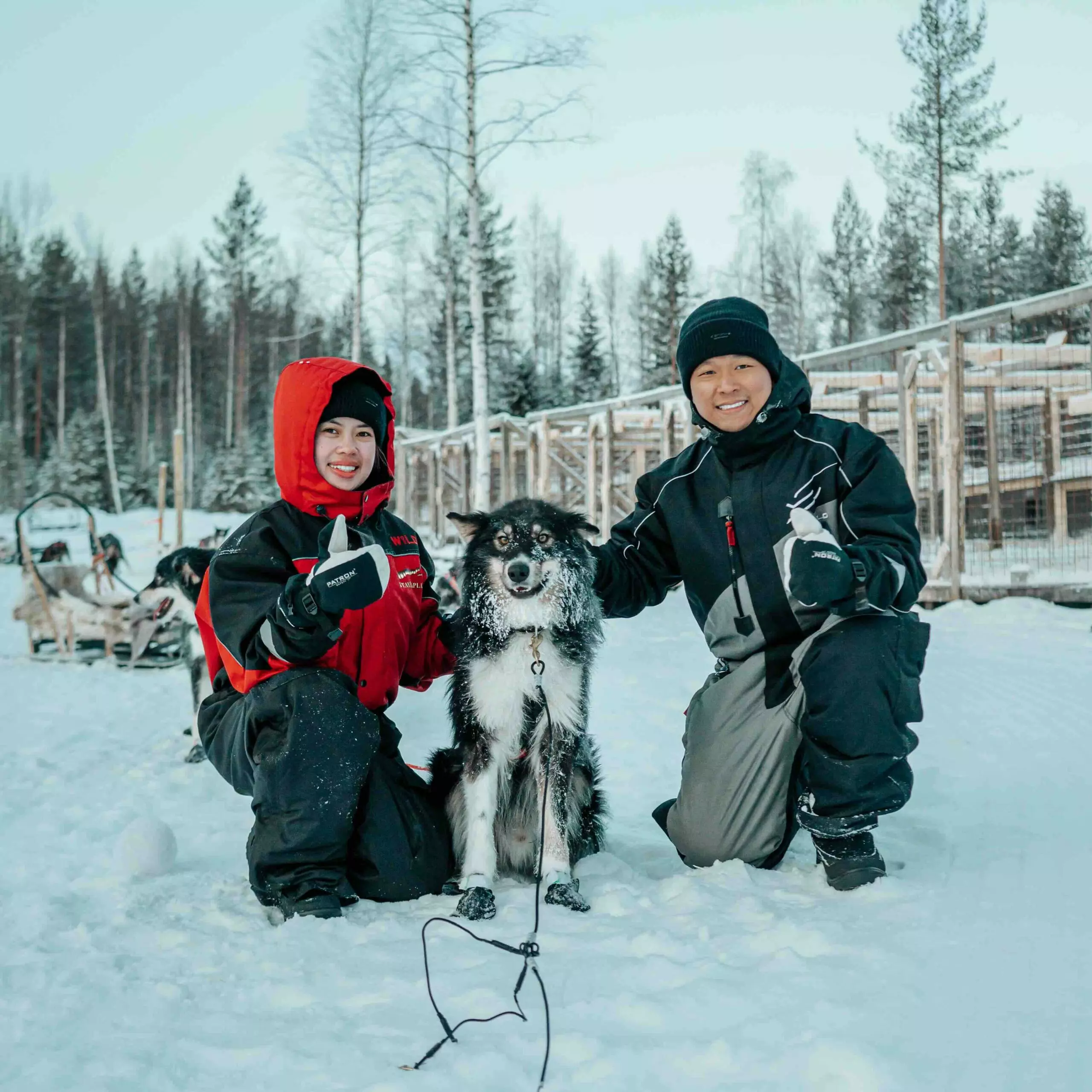
The first thing most guests notice at a husky yard is not the snow or the sleds – it is the sound. As the teams are prepared, the dogs bark, yelp and howl, and for a moment it can feel like the whole forest is singing. Almost everyone asks the same question: why do they do that?
We run our winter husky tours at the Kuoksa Husky Park with our partner kennel, so we hear that chorus every day of the season. In this article we explain what animal-behaviour research says about howling, why huskies are more vocal than most dogs, and how to read what you hear when you join us at the start line.
Short answer: howling is long-range pack communication that dogs inherited from wolves. Research shows that breeds genetically close to wolves – the Siberian husky among them – howl more readily than modern breeds. At the start line the dogs are surrounded by their pack and by the noise of other teams, and one voice sets off the next. Our kennel partners describe the enthusiasm these dogs have for running as the heart of mushing; the chorus is part of how a team that wants to go sounds.
At a glance
- From: 189 €
- Experience type: Husky tour
- Duration: 4 hours
- Difficulty: Easy
- Book in Advance: Cut off: 12 hours before start time
- Included: A Husky Ride 5 Km (Self-driving); Detailed instructions on how to safely mush the Huskies; Information about Huskies; Photos taken with your own device; A Tour Guide in English (other languages available on request: (Spanish, Portuguese, French, Italian, German & Finnish. PLEASE NOTE LIMITED AVAILABILITY FOR OTHER LANGUAGES) If another language is required. Please send us an email or WhatsApp after booking.); Winter clothing (Adult & Child size), overalls, boots & gloves; Cookies and juice; Pick-ups are included in the price within a 10 km radius of Rovaniemi city centre; Between 1 December and 10 January, drop-offs are included only to selected locations: Postmaster Hotel, Rovaniemi City Centre, Ollerovaara area and Santa Claus Village
- Cancellation: Free cancellation 24 hours before the activity. We will charge a cancellation fee of 100% if booking is cancelled less than 24 hours before the activity.
- Accessibility: Not wheelchair accessible; Not stroller accessible
What howling is for: the wolf behind the husky
To understand a howling husky, start with the wolf. A 2023 study in Communications Biology by researchers at Eötvös Loránd University in Budapest summarises the two main functions of howling in wolves: keeping track of where pack members are and holding the pack together, and maintaining territory while avoiding contact with unknown individuals.
A review published in UC Davis’s undergraduate journal The Aggie Transcript describes the same picture: wolves howl for long-distance communication, to signal territory and to foster bonds within the pack, and a howl can be used to locate pack members or to summon the whole pack.
A howl, in other words, is a sound designed to carry – and to be answered.
Why huskies howl more than most dogs
Most domestic dogs rarely howl. The UC Davis review explains that over generations of living close to people, dogs came to rely on barking – a close-range, attention-seeking sound – rather than long-range howls.
Huskies are a well-known exception, and the Budapest study helps explain why. The researchers played wolf howls to 68 purebred dogs from 28 breeds. Dogs from genetically ancient breeds – a group that included the Siberian husky and the Alaskan malamute – responded with more howling, especially older individuals, while dogs from modern breeds were more likely to bark instead. The authors conclude that dogs lose the wolf-like howling response as they become more genetically distant from wolves.
That is why a yard full of northern sled dogs sounds so different from a park full of pet dogs.
Barks, whines and howls: three different messages
The noise at a start line is a mix of sounds, and they do not all mean the same thing. Harmony Diers of the Texas A&M School of Veterinary Medicine & Biomedical Sciences describes the main types:
- Barking expresses emotion – a higher-pitched bark often signals excitement, a sharp and intense bark is an alert.
- Whining communicates needs and feelings, which can include a desire to play or excitement, but also unhappiness or anxiety.
- Howling reflects the long-range communication instinct dogs inherited from wolves. It can be a response to other sounds – including other dogs’ barking – or a way of communicating with the pack.
So when you hear high-pitched barking mixed with howls as harnesses go on, you are hearing a pack talking to itself at full volume.
StayLapland · From 59 €
Arctic Paws — 2 km Family-Friendly Husky Ride at Lapland Winter Park
Easy · Cut off: 15 minutes before start time
Why the chorus starts right before the run
Put those findings together and the start line makes sense. The dogs are with their pack, other teams are being prepared nearby, and howling is a response that spreads: Texas A&M notes that dogs howl in response to other dogs’ barking and to communicate with pack members. One voice sets off the next, and the sound rolls through the yard.
The people who run our husky tours see the motivation behind it every day. In their own words on our Kuoksa Husky Park story, everyone who runs dogs agrees on what happens when you combine the enthusiasm and dedication these dogs have for running with Arctic nature and the forward movement of the sled. The science cannot tell us exactly what each dog is thinking – but the chorus is part of how that enthusiasm sounds.

When a howl means something else
Howling is not always about excitement, and we think it is worth being honest about that. Texas A&M lists alleviating feelings of isolation among the reasons dogs howl, and notes that anxiety-related barking often sounds high-pitched and increases in frequency – something that may need a vet’s attention in a pet dog.
That is why the context matters, and why reading dogs is a skill our musher partners take seriously. Delia, one of the two people behind the Kuoksa Husky Park, trained as a veterinary technician and keeps up to date with veterinary seminars specifically about sled dogs; Bent has worked with sled dogs for fifteen years. Their aim, as they put it, is to adjust their work to the dogs’ needs and earn their trust.
How this shows up on our tours
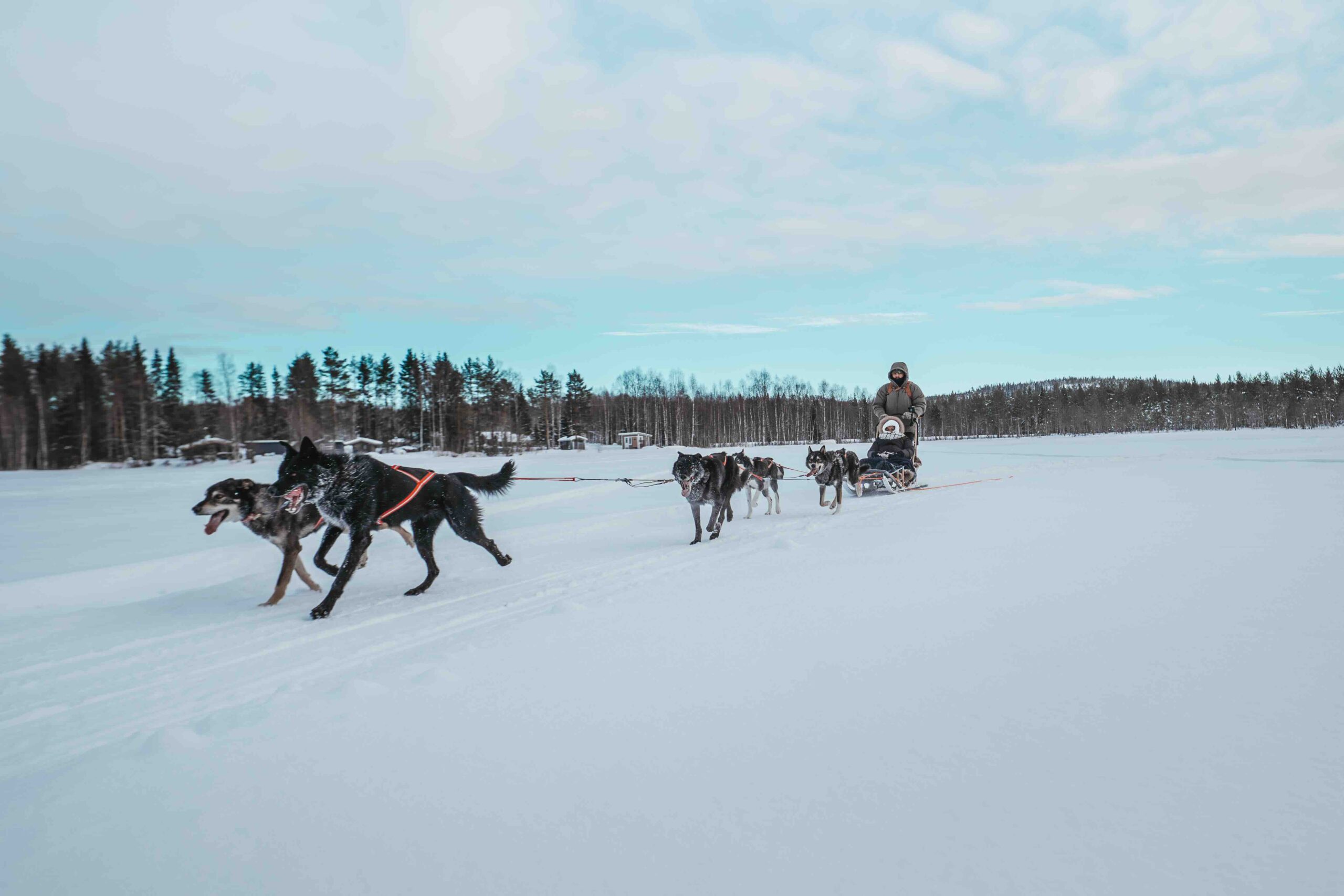
You will hear the start-line chorus for yourself on our Nulkki Husky Adventure. It is a 5 km self-driven husky sleigh ride through the Kuoksajärvi forest, about 4 hours in total. Before you set off, your guide gives you detailed instructions on how to mush the huskies safely and tells you about the dogs – a good moment to ask what you are hearing.
The husky tours at the Kuoksa Husky Park run from November until April, organised together with our partner kennel Tails Ahead Sleddogs. Winter clothing (overalls, boots and gloves) is included, as are cookies and juice and pick-up within a 10 km radius of Rovaniemi city centre. In bad weather the tour can be run as a shortened guide-driven experience for safety, and it may be cancelled or rescheduled in extreme cold – the limit is -35°C, and -25°C for small children.
If you want to see how the dogs prepare before the snow comes, read our posts on husky cart training in autumn and our autumn husky tour. You can browse all our tours on the activities page.
At the start line: a few things that help
- Expect it to be loud, especially as the teams are harnessed – if you are travelling with children, it helps to tell them beforehand.
- Listen to your guide’s briefing before anything else – the instructions on how to stand on the sled and use the brake matter more than any photo.
- Ask your guide before you approach or touch a dog, so the dogs can stay focused on getting ready.
- If you want a calmer, shorter introduction to huskies, choose a guide-driven ride such as Arctic Paws at Lapland Winter Park instead of a self-driven one.
Frequently asked questions
Does howling mean the huskies are unhappy?
Not necessarily. Research describes howling as long-range pack communication inherited from wolves, and dogs also howl in response to other dogs. Howling can also relate to isolation, which is why experienced mushers read the whole dog, not just the sound.
Do all huskies howl?
Not every dog howls equally. A 2023 study found that dogs from genetically ancient breeds, including the Siberian husky, responded to wolf howls with more howling than modern breeds, especially older dogs.
When can I hear the huskies on a StayLapland tour?
Our husky tours at the Kuoksa Husky Park run from November until April, organised together with our partner kennel Tails Ahead Sleddogs.
How long is the Nulkki Husky Adventure?
The Nulkki Husky Adventure includes a 5 km self-driven husky ride and lasts about 4 hours in total. Prices start from 189 €.
Can children join the husky ride?
The Nulkki Husky Adventure is not suitable for children under 3 years old. Children under 13 must be accompanied by adults paying the full price.
What happens if it is extremely cold?
The tour may be cancelled or rescheduled in extreme weather. The temperature limit is -35°C, and -25°C for small children. In bad weather the tour can be run as a shortened guide-driven experience.
Ready to book?
StayLapland · From 189 €
4 hours · Easy · Cut off: 12 hours before start time
Questions before you book? Email booking@staylapland.com or WhatsApp us on +358 40 128 7846.
You may also like
- Arctic Paws — 2 km Family-Friendly Husky Ride at Lapland Winter Park — from 59 €, an approximately 10-minute guide-driven ride (about 2 km)
- Kuoksa Husky & Reindeer Adventure — from 349 €, 5 hours
Sources
- Lehoczki F. et al. (2023): Genetic distance from wolves affects family dogs’ reactions towards howls – Communications Biology
- Texas A&M School of Veterinary Medicine & Biomedical Sciences – ‘Howl’ to communicate with your dog
- The Aggie Transcript, UC Davis – Vocal communication in the domestic dog