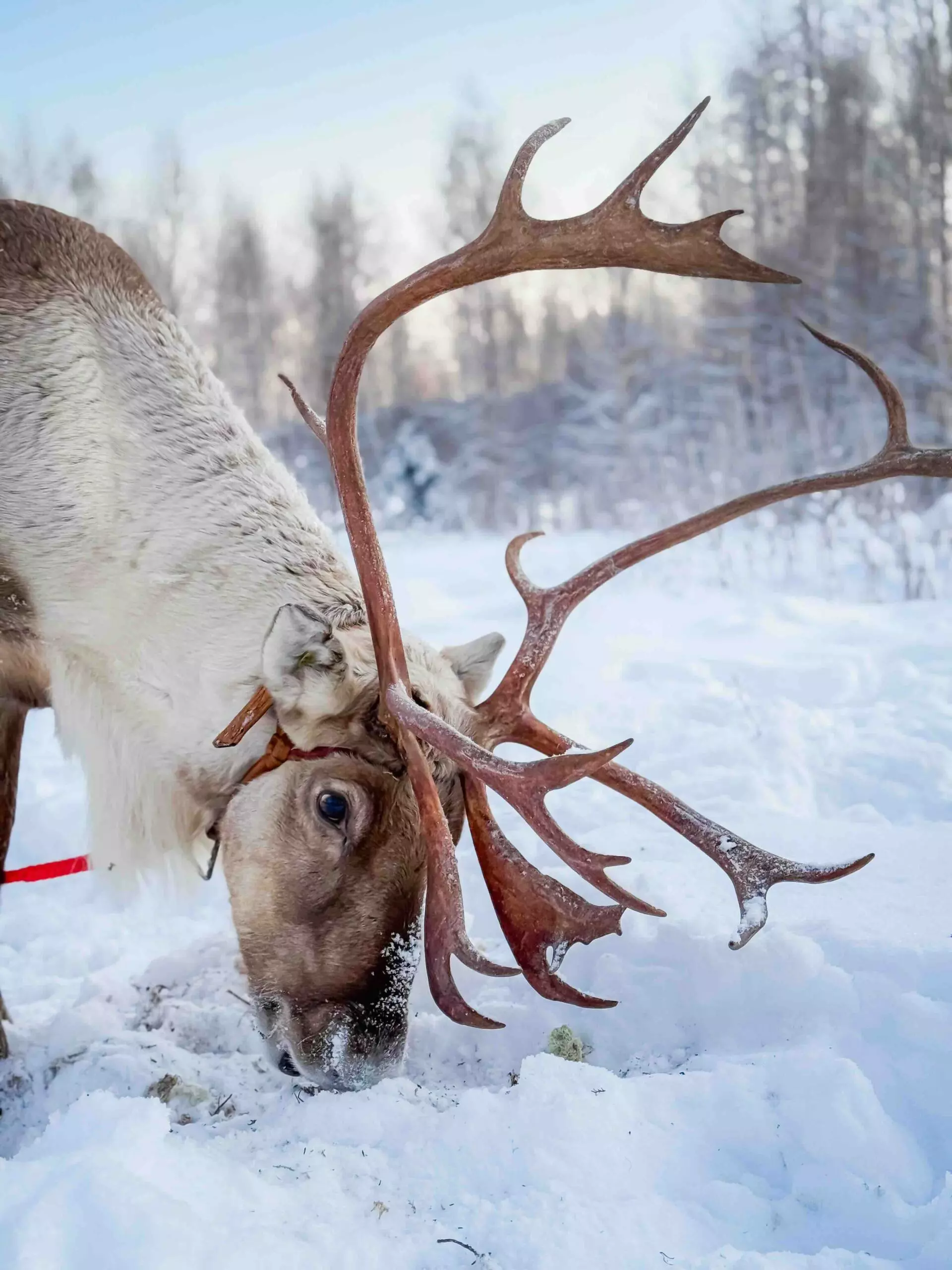
Ask a reindeer herder what surprises visitors most and you will hear many answers: the antlers, the calm, the clicking sound of their feet. One fact that surprises almost everyone is this: reindeer eyes change colour with the seasons. In summer the reflective layer at the back of a reindeer’s eye is gold. In winter it turns deep blue.
We spend the winter months out in the forest with reindeer, so we wanted to explain this properly, using the published research rather than folklore. Below is what the scientists found, how the change works, and why it matters for an animal that lives through long, dim Arctic winters.
The short answer: yes, reindeer eyes change colour. Research led by Professor Glen Jeffery at the UCL Institute of Ophthalmology, with the University of Tromsø in Norway, published in Proceedings of the Royal Society B in 2013, found that a layer behind the retina called the tapetum lucidum is gold in summer and deep blue in winter. The winter blue helps the eye catch more of the scarce light during the dark season.
At a glance
- From: 159 €
- Experience type: Reindeer tour
- Duration: 3 hours
- Difficulty: Very easy
- Book in Advance: Cut off: 12 hours before start time
- Included: 2-3 km reindeer safari in the forest of Lapland; Information about the life of reindeer, reindeer farm and reindeer herding in general; A Tour Guide in English (other languages available on request: (Spanish, Portuguese, French, Italian, German & Finnish. PLEASE NOTE LIMITED AVAILABILITY FOR OTHER LANGUAGES) If another language is required. Please send us an email or WhatsApp after booking.); Winter clothing (Adult & Child size), overalls, boots, gloves, socks; Cookies and juice; Photos taken with your own device; Pick-ups are included in the price within a 10 km radius of Rovaniemi city centre; Between 1 December and 10 January, drop-offs are included only to selected locations: Postmaster Hotel, Rovaniemi City Centre, Ollerovaara area and Santa Claus Village; Air conditioned car
- Cancellation: Free cancellation 24 hours before the activity. We will charge a cancellation fee of 100% if booking is cancelled less than 24 hours before the activity.
- Accessibility: Not wheelchair accessible; Not stroller accessible
StayLapland · From 159 €
3 hours · Very easy · Cut off: 12 hours before start time
#bokun_c105804a_054d_c4da_53c8_309a95880007 { display: inline-block; padding: 10px 20px; background: #408C3D; border-radius: 5px; box-shadow: none; font-weight: 600; font-size: 16px; text-decoration: none; text-align: center; color: #FFFFFF; border:none; cursor: pointer; transition: background .2s ease; } #bokun_c105804a_054d_c4da_53c8_309a95880007:hover{ background: #285726; } #bokun_c105804a_054d_c4da_53c8_309a95880007:active{ background: #30682e; }What actually changes colour: the tapetum lucidum
The colour change is not in the iris, the part of a human eye we call “eye colour”. It happens in the tapetum lucidum, a reflective tissue layer that sits behind the retina in many mammals. Its job is to bounce light back through the retina, giving the light-sensitive cells a second chance to catch it.
According to UCL’s report on the 2013 study, the tapetum of Arctic reindeer is gold in summer, when it reflects most light straight back out through the retina. In winter it is deep blue. Later work at UCL describes the summer reflection as gold-turquoise.

How the switch from gold to blue happens
The researchers traced the change to pressure inside the eye. In the long winter darkness, reindeer pupils stay dilated for long periods. UCL explains that this is linked to fluid not draining normally from the eye, which raises the pressure inside it.
That pressure compresses the tapetum. The tapetum is made of very fine collagen fibres – according to UCL Ophthalmology researcher Dr Robert Fosbury, too small to be seen with a light microscope – arranged in a regular pattern. When the fibres are squeezed closer together, the spacing between them shrinks, and the layer reflects shorter wavelengths. Shorter wavelengths mean blue.
This is structural colour: the blue comes from the geometry of the tissue, not from a pigment, in the same way that some feathers and butterfly wings get their colour.
Why blue is better in the Arctic winter
The winter tapetum reflects less light back out of the eye and scatters more of it through the photoreceptors, according to the 2013 UCL findings. For an animal that has to find food and watch for danger through months of low light, that extra sensitivity is valuable.
There is a second part of the story. In a 2022 article, Dr Robert Fosbury of UCL explained that twilight has an unusual property: it is extremely blue, with very little green, yellow or orange. That is because the Earth’s ozone layer, in twilight, absorbs almost all light except blue. In the Arctic winter, when the sun stays low, that blue twilight makes up a large share of the light available.
A blue-tuned tapetum is therefore well matched to the light a reindeer actually lives in during winter.
StayLapland · From 159 €
3,5 hours · Easy · Cut off: 8 hours before start time
#bokun_44de810e_68b9_0da1_36ae_f9c6ae9a075d { display: inline-block; padding: 10px 20px; background: #408C3D; border-radius: 5px; box-shadow: none; font-weight: 600; font-size: 16px; text-decoration: none; text-align: center; color: #FFFFFF; border:none; cursor: pointer; transition: background .2s ease; } #bokun_44de810e_68b9_0da1_36ae_f9c6ae9a075d:hover{ background: #285726; } #bokun_44de810e_68b9_0da1_36ae_f9c6ae9a075d:active{ background: #30682e; }Finding lichen and spotting wolves
Why would a reindeer need to see well in blue twilight? The 2022 UCL article gives two practical reasons.
- Food. In winter, reindeer find and uncover their main food, lichen, by brushing away snow. Lichen reflects less blue light than snow does, so it appears dark against the snowy ground.
- Predators. Wolf fur also reflects less blue than other colours, so a wolf stands out as a darker shape against snow.
The same article notes that wolves, too, have a tapetum that improves their sensitivity to Arctic twilight – a reminder that this is an evolutionary contest between two species adapted to the same dim light.
Reindeer can see ultraviolet light too
The UCL report also notes that Arctic reindeer can perceive ultraviolet light, which is abundant in the Arctic environment. The researchers link this ability to predator detection and finding food.
Taken together, the gold-to-blue switch and ultraviolet sensitivity show how closely reindeer eyes are tuned to life in the far north, where the balance of light changes dramatically between summer and winter.
How this shows up on our tours
We visit reindeer in the forest throughout the winter on the Kuoksa Reindeer Adventure (from 159 €, 3 hours). The tour includes a 2–3 km reindeer safari in the Lapland forest and information about the life of reindeer, the reindeer farm and reindeer herding in general – a good moment to ask the herder about seasonal changes like this one. If the weather does not allow a sleigh ride, the tour is arranged as a reindeer walk instead.
If you would like to meet reindeer in the evening, our Northern Lights Tour Reindeer Safari (from 179 €, 3,5 hours) combines a 2–3 km reindeer safari in the forest with a search for the aurora. For a daytime combination, Ice Fishing with Reindeer (from 159 €, 3,5 hours) pairs a reindeer sleigh ride with ice fishing by the fire.
More reindeer experiences are listed in our reindeer activities in Rovaniemi. If you are curious about the reindeer year, read our explanation of the autumn reindeer roundup, and for the other big story of the winter sky, how auroras are formed.
Frequently asked questions
Do reindeer eyes really change colour?
Yes. Research from UCL and the University of Tromsø found that the reflective layer behind the reindeer retina, the tapetum lucidum, is gold in summer and deep blue in winter.
Which part of the reindeer eye changes colour?
The tapetum lucidum, a reflective layer behind the retina. It is not the iris.
Why do reindeer eyes turn blue in winter?
Pressure inside the eye rises during the dark months, compressing the collagen fibres of the tapetum. The tighter spacing reflects shorter, blue wavelengths, and the winter tapetum scatters more light through the photoreceptors.
Who discovered that reindeer eyes change colour?
A team led by Professor Glen Jeffery at the UCL Institute of Ophthalmology, working with the University of Tromsø, published the findings in Proceedings of the Royal Society B in 2013.
Can reindeer see ultraviolet light?
Yes. UCL reports that Arctic reindeer can perceive ultraviolet light, which is abundant in the Arctic, and link it to spotting predators and finding food.
Where can I meet reindeer with StayLapland?
On the Kuoksa Reindeer Adventure, which includes a 2–3 km reindeer safari in the forest and information about reindeer herding, or on our Northern Lights Tour Reindeer Safari and Ice Fishing with Reindeer.
Ready to book?
StayLapland · From 159 €
3 hours · Very easy · Cut off: 12 hours before start time
#bokun_d5da5ccc_dd5c_8aed_feb5_f3bf6ff43048 { display: inline-block; padding: 10px 20px; background: #408C3D; border-radius: 5px; box-shadow: none; font-weight: 600; font-size: 16px; text-decoration: none; text-align: center; color: #FFFFFF; border:none; cursor: pointer; transition: background .2s ease; } #bokun_d5da5ccc_dd5c_8aed_feb5_f3bf6ff43048:hover{ background: #285726; } #bokun_d5da5ccc_dd5c_8aed_feb5_f3bf6ff43048:active{ background: #30682e; } #bokun_626aef05_4a8b_c8ba_05dd_d737c2abde4f { display: inline-block; padding: 10px 20px; background: #408C3D; border-radius: 5px; box-shadow: none; font-weight: 600; font-size: 16px; text-decoration: none; text-align: center; color: #FFFFFF; border:none; cursor: pointer; transition: background .2s ease; } #bokun_626aef05_4a8b_c8ba_05dd_d737c2abde4f:hover{ background: #285726; } #bokun_626aef05_4a8b_c8ba_05dd_d737c2abde4f:active{ background: #30682e; }Questions about our reindeer tours? Email booking@staylapland.com or WhatsApp +358 40 128 7846.
You may also like
- Ice Fishing with Reindeer — from 159 €, 3,5 hours
- Northern Lights Tour Reindeer Safari — from 179 €, 3,5 hours
Sources
- UCL News (2013): Reindeers’ eyes change colour with Arctic seasons
- UCL News (2022): How reindeer eyes transform in winter to give them twilight vision