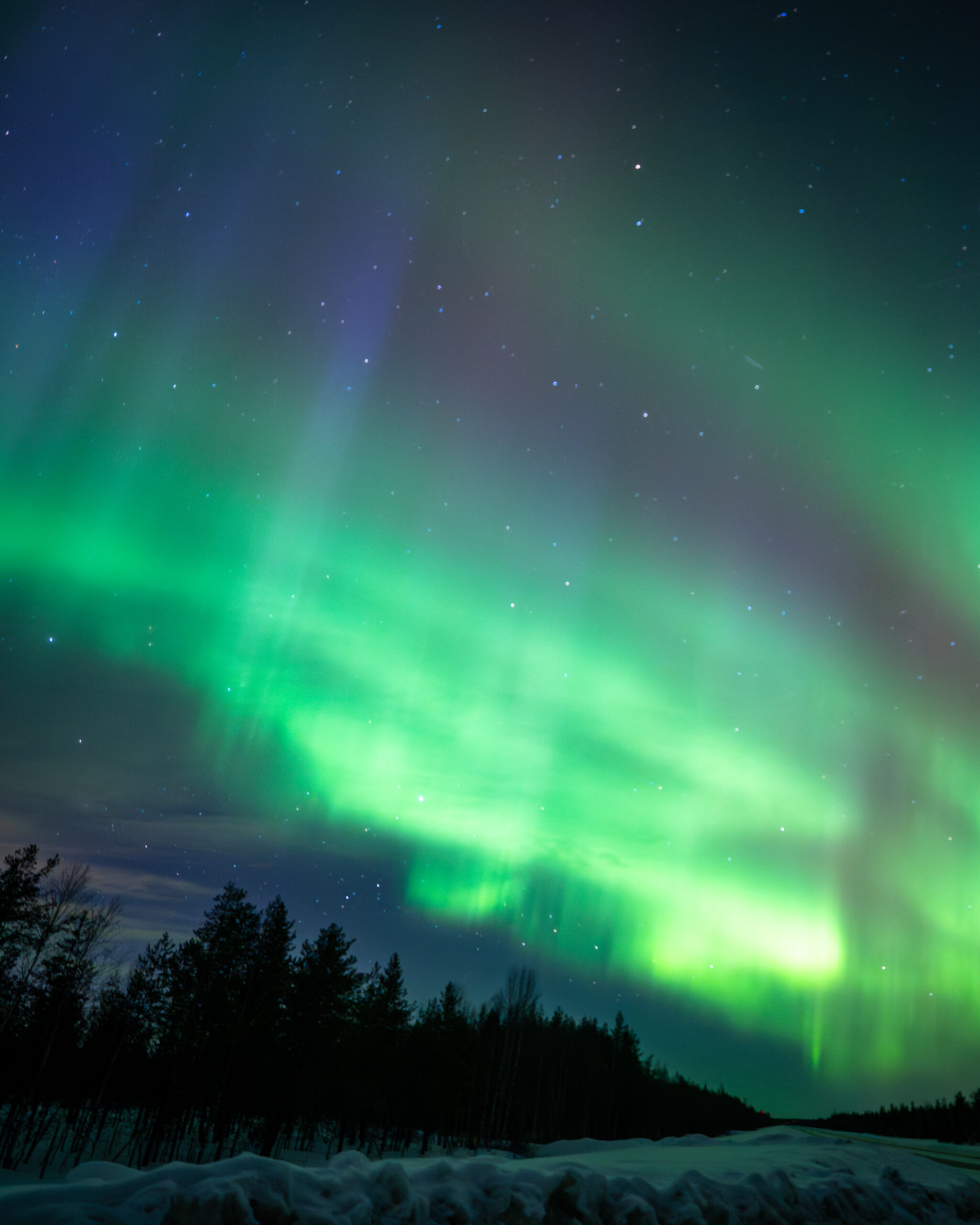
Why green? It is a natural question the first time you see the northern lights, or the first time you look at aurora photos from Lapland. The colours are not random.
The answer is chemistry. The colour of an aurora tells you which gas in the upper atmosphere is glowing and roughly how high up it is happening. Below we explain it in plain language, using figures from NASA, NOAA’s Space Weather Prediction Center and the Finnish Meteorological Institute, and then how it shows up on our own Northern Lights evenings around Rovaniemi.
Short answer: according to NASA, the most common aurora colour is green, and it is produced when oxygen is excited by electrons around 100 km above Earth’s surface. Oxygen higher up (above about 200 km) glows red, and nitrogen gives blue or pink tones. When these mix, auroras can look purple, pink or even white.
At a glance
- From: 99 €
- Experience type: Northern Lights tour / activity
- Duration: 3 hours
- Difficulty: Very easy
- Book in Advance: Cut off: 3 hours before start time
- Included: A Tour Guide in English (other languages available on request: (Spanish, Portuguese, French, Italian, German & Finnish. PLEASE NOTE LIMITED AVAILABILITY FOR OTHER LANGUAGES) If another language is required. Please send us an email or WhatsApp after booking.); Winter clothing (Adult & Child size), overalls, boots, gloves, socks; Local Snack & Drinks by the campfire; Information about the Northern Lights; Pick-ups and drop-offs are included in the price in 10 km radius from Rovaniemi city center; Photos taken with your own device; Air conditioned car
- Cancellation: Free cancellation 24 hours before the activity. We will charge a cancellation fee of 100% if booking is cancelled less than 24 hours before the activity.
- Accessibility: Not wheelchair accessible; Not stroller accessible
StayLapland · From 99 €
Northern Lights Tour At The Campfire
3 hours · Very easy · Cut off: 3 hours before start time
#bokun_43933b63_5221_6b9c_fcc8_0cc8d61e360a { display: inline-block; padding: 10px 20px; background: #408C3D; border-radius: 5px; box-shadow: none; font-weight: 600; font-size: 16px; text-decoration: none; text-align: center; color: #FFFFFF; border:none; cursor: pointer; transition: background .2s ease; } #bokun_43933b63_5221_6b9c_fcc8_0cc8d61e360a:hover{ background: #285726; } #bokun_43933b63_5221_6b9c_fcc8_0cc8d61e360a:active{ background: #30682e; }Book Early the Activities for Winter 2026–2027 – Save 10% with code EARLY27 01.11.2026–31.03.2027 (Excludes husky & reindeer tours)
How an aurora is made
The Sun continuously sends out a stream of charged particles called the solar wind. When it reaches Earth, it interacts with Earth’s magnetic field and deposits energy there (NASA). NOAA’s Space Weather Prediction Center describes the result: electrons are energised in the night-side tail of the magnetosphere, follow Earth’s magnetic field towards the polar regions and collide with the upper atmosphere, where they strike oxygen and nitrogen.
In those collisions the electrons pass their energy to the atoms and molecules, lifting them to higher energy states. When they relax back down, they release that energy as light. NOAA gives the typical height of the aurora as 80 to 500 km above Earth’s surface, far above the clouds.
We cover the formation side in more detail in How are auroras formed?. Here we focus on the colours.
Green: oxygen at around 100–200 km
Green is the colour of oxygen. NASA’s Earth Observatory explains that oxygen excited to different energy levels can produce green and red, and that the green occurs roughly between 100 and 200 km altitude. NASA’s aurora overview adds that green is the most common colour, produced when oxygen is excited by electrons around 100 km above the surface.
That is why the classic Lapland aurora, the curtain or band stretching across the sky, is usually green: it is the most common aurora colour.
Red: oxygen higher up
The same gas, oxygen, can also glow red. According to NASA’s Earth Observatory, red occurs above about 200 km. So in a tall display you sometimes see a green lower edge with a red or crimson top: you are looking at oxygen glowing at two different heights.
We never promise a particular colour on any tour, because nobody can: what appears depends on the night.
StayLapland · From 109 €
Northern Lights Tour in Atmospheric Cottage
3 hours · Very easy · Cut off: 3 hours before start time
#bokun_f12e8aca_ef73_098d_b247_82edc5157b4c { display: inline-block; padding: 10px 20px; background: #408C3D; border-radius: 5px; box-shadow: none; font-weight: 600; font-size: 16px; text-decoration: none; text-align: center; color: #FFFFFF; border:none; cursor: pointer; transition: background .2s ease; } #bokun_f12e8aca_ef73_098d_b247_82edc5157b4c:hover{ background: #285726; } #bokun_f12e8aca_ef73_098d_b247_82edc5157b4c:active{ background: #30682e; }Book Early the Activities for Winter 2026–2027 – Save 10% with code EARLY27 01.11.2026–31.03.2027 (Excludes husky & reindeer tours)
Blue, pink and purple: nitrogen and mixing
Nitrogen supplies the other colours. NASA’s Earth Observatory says excited nitrogen, from about 100 to 200 km, glows blue or pink depending on the type and energy of the particles it interacts with. A NASA visualisation of aurora colours also lists pink from nitrogen lower down, below about 100 km.
When light from the different gases overlaps, the colours appear to mix, and the aurora can look purple, pink or even white (NASA Earth Observatory). That mixing is where purple tones come from.
Why your camera sees more colour than your eyes
NASA notes that digital camera sensors are so sensitive that they can record auroras you cannot see with the naked eye.
Our tour pages say the same thing in practical terms: the Northern Lights look stronger on camera than to the naked eye. This is also why we include professional photos on our hunting tours.
When you can see the colours in Finland
To see any colour you first need darkness and a clear sky. The Finnish Meteorological Institute (FMI) says that in Lapland auroras are quite common always, even during solar minimum, but in summer the nights are too light to see them. Its guidance for observers:
- The best time of night is between 9 p.m. and 1 a.m. local time.
- The best months are February–March and September–October.
- You need a dark, open place, preferably far away from town lights, on a dark and cloudless night.
FMI also gives a sense of how often they appear: in northern Lapland around Kilpisjärvi and Utsjoki, three nights out of four have auroras, and in Sodankylä every second night is an auroral night. For what the current solar cycle means for the coming winters, see solar maximum and the Northern Lights.
How this shows up on our tours
Everything above explains what you see; our job is to get you somewhere dark, warm and well placed to see it. We run several Northern Lights evenings from Rovaniemi:
- Northern Lights Tour At The Campfire, from 99 €, 3 hours: we pick you up within 10 km of Rovaniemi city centre, lend you winter clothing, and wait for the auroras by the campfire in our teepee with a local snack and a hot drink. The guide gives you information about the Northern Lights, so this is where you can ask about the colours as they appear.
- Northern Lights Tour in Atmospheric Cottage, from 109 €, 3 hours, at a traditional lakeside cottage about 20 minutes from the city.
- Professional Guaranteed Northern Lights Hunting Tour from Rovaniemi by Bus, from 109 €, and the Professional Small Group Northern Lights Hunting Tour, from 199 €: our guides study cloud and aurora forecasts and drive to the clearest skies, with professional DSLR photos and a 100% refund if we don’t capture any auroras.
If you stay at Aurora Hill Resort, the free Northern Lights Alert App notifies you when the lights appear at the resort. All our experiences are on the activities page.
Frequently asked questions
Why are the northern lights mostly green?
Because the most common aurora light comes from oxygen atoms excited by electrons around 100 km above the ground, which glow green (NASA).
What makes a red aurora?
Oxygen higher in the atmosphere, above about 200 km, glows red (NASA Earth Observatory). Red often appears as the upper part of a tall display.
What causes blue and purple auroras?
Excited nitrogen at about 100–200 km glows blue or pink, and where the colours from different gases mix the aurora can look purple, pink or white (NASA Earth Observatory).
Why do my photos show more colour than I saw?
Camera sensors are very sensitive and can record auroras you cannot see with the naked eye (NASA). On our tours we say it plainly: the Northern Lights look stronger on camera than to the naked eye.
How high up are the northern lights?
NOAA’s Space Weather Prediction Center gives a typical range of 80 to 500 km above Earth’s surface.
When is the best time to see the northern lights in Finland?
The Finnish Meteorological Institute recommends 9 p.m. to 1 a.m. local time, with February–March and September–October as the best months, on a dark and cloudless night away from town lights.
Ready to book?
StayLapland · From 99 €
Northern Lights Tour At The Campfire
3 hours · Very easy · Cut off: 3 hours before start time
#bokun_bcc32030_ddc8_cbb5_bd63_54e97a8b1320 { display: inline-block; padding: 10px 20px; background: #408C3D; border-radius: 5px; box-shadow: none; font-weight: 600; font-size: 16px; text-decoration: none; text-align: center; color: #FFFFFF; border:none; cursor: pointer; transition: background .2s ease; } #bokun_bcc32030_ddc8_cbb5_bd63_54e97a8b1320:hover{ background: #285726; } #bokun_bcc32030_ddc8_cbb5_bd63_54e97a8b1320:active{ background: #30682e; } #bokun_8b1e18fd_1506_4965_001d_f1a696e14b9a { display: inline-block; padding: 10px 20px; background: #408C3D; border-radius: 5px; box-shadow: none; font-weight: 600; font-size: 16px; text-decoration: none; text-align: center; color: #FFFFFF; border:none; cursor: pointer; transition: background .2s ease; } #bokun_8b1e18fd_1506_4965_001d_f1a696e14b9a:hover{ background: #285726; } #bokun_8b1e18fd_1506_4965_001d_f1a696e14b9a:active{ background: #30682e; }Book Early the Activities for Winter 2026–2027 – Save 10% with code EARLY27 01.11.2026–31.03.2027 (Excludes husky & reindeer tours)
Questions before you book? Email booking@staylapland.com or WhatsApp +358 40 128 7846 and our team will help.
You may also like
- Northern Lights Tour in Atmospheric Cottage — from 109 €, 3 hours
- Professional Guaranteed Northern Lights Hunting Tour from Rovaniemi by Bus — from 109 €, Total duration of tour is usually 4-5 hours depends on conditions of the day
- Professional Small Group Northern Lights Hunting Tour from Rovaniemi – Guaranteed — from 199 €, Total duration of tour is usually 4-10 hours depends on conditions of the day
Sources
- NASA Science — Auroras
- NASA Earth Observatory — Purple Haze Aurora
- NASA Scientific Visualization Studio — Different colours of auroras (PDF)
- NOAA Space Weather Prediction Center — Aurora
- Finnish Meteorological Institute — Northern lights
- Finnish Meteorological Institute — Auroras in Finland