Every September our guides come back from the forest at Kuoksa with the same photos on their phones: fells and forest floors that have turned yellow, orange, red and almost purple in a matter of days. In Finnish this has its own word – ruska – and for many people who live in Lapland it is the most beautiful time of the year.
Guests often ask us why the colours up here seem so strong and why they appear so quickly. The answer is a mix of plant chemistry, day length and weather. Below we explain it using what Finnish research institutions and tourism boards have published, and then tell you where you can see the season on our own tours.
In short: ruska happens when plants stop producing chlorophyll in autumn. The yellow and orange pigments that were in the leaves all summer become visible, and some plants also produce new red pigments called anthocyanins. According to the University of Oulu, the colours advance from north to south, peaking in Utsjoki around 10 September, and clear, cool days with light night frosts give the most vivid reds.
At a glance
- From: 133 €
- Experience type: Early winter Husky tour
- Duration: 2 hours
- Difficulty: Very easy
- Book in Advance: Cut off: 4 hours before start time
- Included: Guided husky ride of 5 km (on carts only 3Km); Modern husky kennel visit; Transfers from/to Santa Claus Village, Hostel Cafe Koti in the city center, Arctic SnowHotel or with own transfer at the K-Market Sinettä.; Hot juice and cookies; Informative talk about huskies.
- Cancellation: We will charge a cancellation fee of 100% if booking is cancelled 7 days or less before the event. We will charge a cancellation fee of 10% if booking is cancelled 365 days or less before the event.
- Accessibility: Not wheelchair accessible; Not stroller accessible
StayLapland · From 133 €
Running with the Pack, 3km Husky Tour & Kennel Visit AVAILABLE 8.10–14.11
2 hours · Very easy · Cut off: 4 hours before start time
What “ruska” means
Ruska is simply the Finnish name for the autumn colour season – the weeks when birch, aspen and rowan trees and the low shrubs on the forest floor change from green to yellow, orange and red. Visit Finland describes how, in Lapland, the shrubs turn into “a proverbial autumnal sea” of colour.
What makes Lapland special is not only the trees but the ground layer. On open fells and in pine forests, much of the colour comes from knee-high plants such as bilberry and dwarf birch, so whole slopes change colour at once rather than just the treetops.
The science: where the yellow and the red come from
During summer, leaves are green because of chlorophyll, the pigment plants use for photosynthesis. The University of Oulu’s nature pages explain that in autumn the nitrogen-containing components of chlorophyll are moved into the plant for winter storage. As the green disappears, other pigments show through:
- Yellow and orange come from xanthophylls and carotenoids – pigments that are in the leaf all summer but are masked by chlorophyll.
- Red and purple come from anthocyanins, which develop in the leaf cells in autumn. The same source notes that they may protect the leaf against frost damage or UV radiation under stressful conditions.
Visit Finland summarises the same process in simpler words: cold weather and decreasing light stop photosynthesis, and the fading green reveals the colours we call ruska.
Why it starts in the north
The timing is driven above all by day length. The University of Oulu writes that the start of autumn colour depends on the lengthening of the nights rather than temperature alone – which is why it arrives first in the far north, where the nights lengthen fastest after midsummer.
The same source gives a typical progression for peak colours:
- Utsjoki, at the northern tip of Finland: around 10 September
- Kuusamo: around 15 September
- Oulu: around 20 September
- Southern Finland: 1–2 weeks later
Visit Finland puts the peak in northern Finland in the second week of September, lasting about ten days, and notes that ruska moves from north to south by around 500 kilometres in just a couple of weeks.
StayLapland · From 89 €
3 hours · Easy · Cut off: 8 hours before start time
Book Early the Activities for Winter 2026–2027 – Save 10% with code EARLY27 01.11.2026–31.03.2027 (Excludes husky & reindeer tours)
Which plants change colour – and to what
Different species turn at different times, which is why the season looks different week by week. The University of Oulu lists the main players in the north:
- Trees: birch, aspen and rowan. Visit Finland describes aspen turning deep red and orange, rowans with multi-coloured leaves and berries, and falling birch leaves that feel like walking through golden rain.
- The ground layer: dwarf birch, bilberry, bog bilberry and bearberry, which give the fells their red and orange carpet.
- Quieter tones: cloudberry and crowberry take on modest reddish shades.
- Conifers: pine and spruce show only a modest brown, as they shed just their oldest needles.
What makes a “good” ruska year
Some autumns are remembered for their colours and some pass almost unnoticed. According to the University of Oulu, clear, cool days and light frosts at night produce the most vivid anthocyanin colouring – in other words, the strongest reds.
Visit Rovaniemi notes that around the Arctic Circle the first signs of autumn may appear towards the end of August, that September generally offers the most vibrant colours, with the middle weeks often especially spectacular, and that the beginning of October can still offer beautiful autumn scenery before early winter takes over.
Ruska and the return of the Northern Lights
Ruska coincides with another change: the nights are dark again. Visit Rovaniemi points out that from late August onwards the darker nights create the right conditions for the Northern Lights to return. That is why autumn in Lapland can offer colourful forests by day and, on clear nights, the aurora above them.
Autumn is also a busy season in nature for other reasons – it is the reindeer mating season, as we explain on our reindeer information page, and we have written about the season in our ruska article for Rovaniemi and about Lapland’s mushrooms.
How this shows up on our tours
We see ruska most closely in our own forests. On the Wild Berry Hunt (from 89 €, 3 hours) our guide takes you through our private forest areas to pick seasonal berries and then stops by a lakeside with light snacks and drinks by the campfire. The product page lists September as the lingonberry picking season, which is also when the bilberry shrubs around you are turning red.
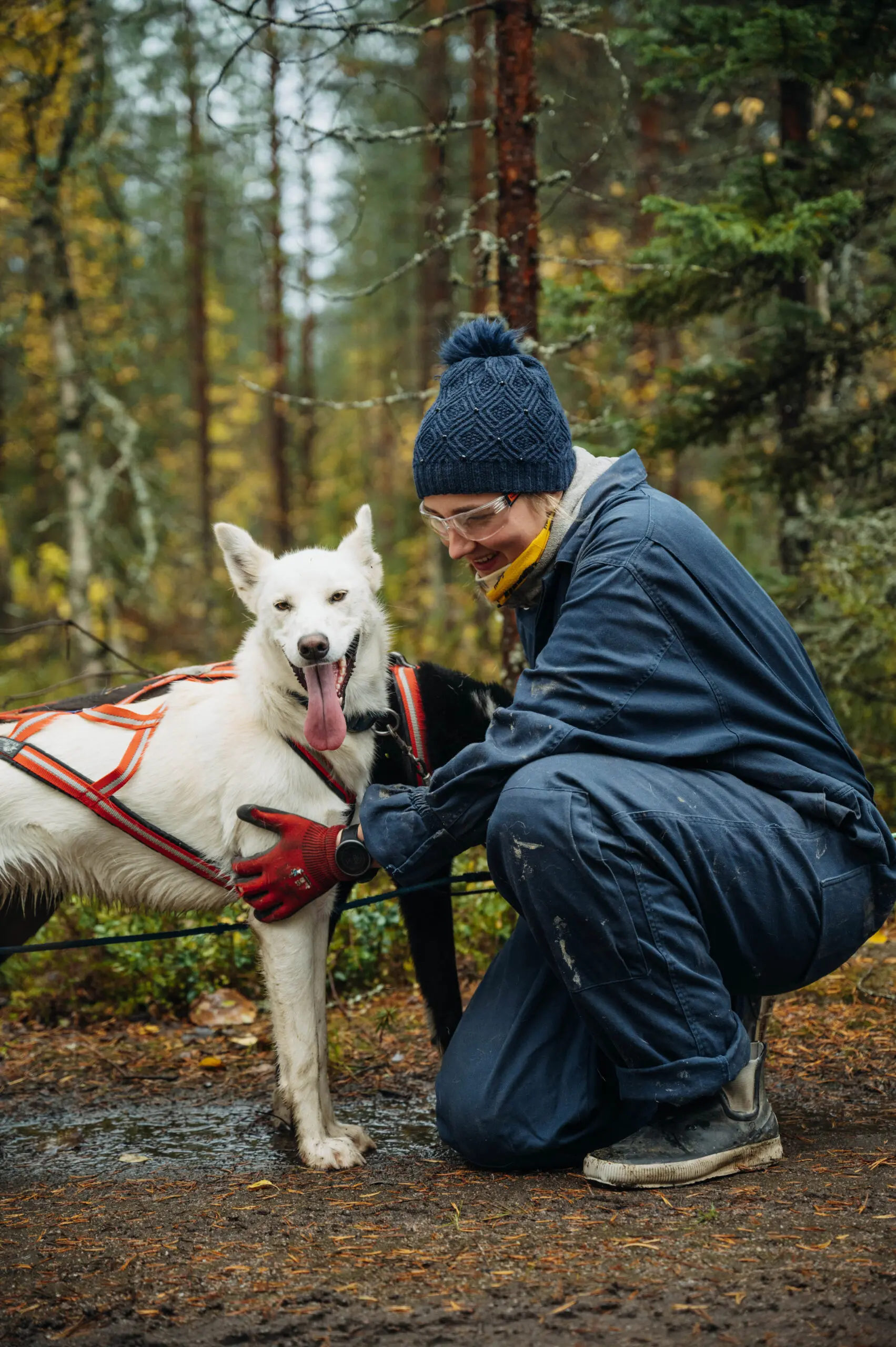
As autumn turns towards winter, Running with the Pack (from 133 €, 2 hours) lets you visit the husky kennel, meet the dogs and ride behind them in an autumn window shown on the tour page. Until there is enough snow the ride is done on carts and is 3 km long, and for the dogs’ welfare it runs only when it is 10 °C or colder. We do not provide extra clothing on this tour, and the FAQ on the tour page reminds you that it can be muddy – so dress for the weather.
You can see all our seasonal tours on the activities in Rovaniemi page.
Frequently asked questions
What does ruska mean?
Ruska is the Finnish word for the autumn colour season, when trees and forest-floor plants turn yellow, orange and red.
When is ruska in Lapland?
The University of Oulu gives a peak around 10 September in Utsjoki and around 15 September in Kuusamo; Visit Rovaniemi says September generally offers the most vibrant colours around Rovaniemi. Every year is slightly different.
Why are some leaves red and others yellow?
Yellow and orange come from carotenoids and xanthophylls that were in the leaf all summer. Red and purple come from anthocyanins, which some plants produce in autumn.
What weather gives the best colours?
According to the University of Oulu, clear, cool days and light night frosts produce the most vivid reds.
Is clothing provided on Running with the Pack?
No. We do not provide extra clothing on this tour, so please dress according to the weather; it can be muddy in autumn.
How do I book an autumn tour with StayLapland?
Use the booking button on this page, or contact us at booking@staylapland.com or on WhatsApp +358 40 128 7846.
Ready to book?
StayLapland · From 133 €
Running with the Pack, 3km Husky Tour & Kennel Visit AVAILABLE 8.10–14.11
2 hours · Very easy · Cut off: 4 hours before start time
Questions about our autumn tours? Email booking@staylapland.com or WhatsApp +358 40 128 7846.
You may also like
- Wild Berry Hunt — from 89 €, 3 hours
Sources
- University of Oulu – North Nature: Kasvien syksy on väriloistoa (autumn colours of plants)
- Visit Finland – Best ways to experience fall foliage in Finland
- Visit Rovaniemi – Arctic autumn colours in Rovaniemi