
The first thing most of our guests look at when they reach the husky yard is the dogs. The second is the sled, usually with a slightly worried question: where do I stand, how do I stop it, and how on earth do I steer?
Below we go through the parts of a dog sled one by one, using the dog-mushing terminology published by the University of Alaska Fairbanks and material from the Iditarod’s education programme and the Smithsonian. Then we explain what that means in practice when you drive a team yourself on our Nulkki Husky Adventure.
In short: a dog sled has two runners that touch the snow, a basket (the main body) held up by upright stanchions, a curved brush bow at the front and a handlebar, also called the driving bow, at the back for the driver to hold. Speed is controlled with the brake, a metal claw you stand on, and the drag mat, a piece of rubber that slows the sled; the snow hook anchors the team when it stops. The dogs are connected by the gangline. Steering is mostly done by the lead dogs following the trail and the musher’s voice, while a slight curve in the runners gives the sled a pivot point for turning.
At a glance
- From: 189 €
- Experience type: Husky tour
- Duration: 4 hours
- Difficulty: Easy
- Book in Advance: Cut off: 12 hours before start time
- Included: A Husky Ride 5 Km (Self-driving); Detailed instructions on how to safely mush the Huskies; Information about Huskies; Photos taken with your own device; A Tour Guide in English (other languages available on request: (Spanish, Portuguese, French, Italian, German & Finnish. PLEASE NOTE LIMITED AVAILABILITY FOR OTHER LANGUAGES) If another language is required. Please send us an email or WhatsApp after booking.); Winter clothing (Adult & Child size), overalls, boots & gloves; Cookies and juice; Pick-ups are included in the price within a 10 km radius of Rovaniemi city centre; Between 1 December and 10 January, drop-offs are included only to selected locations: Postmaster Hotel, Rovaniemi City Centre, Ollerovaara area and Santa Claus Village
- Cancellation: Free cancellation 24 hours before the activity. We will charge a cancellation fee of 100% if booking is cancelled less than 24 hours before the activity.
- Accessibility: Not wheelchair accessible; Not stroller accessible
The frame: runners, stanchions, basket and brush bow
The University of Alaska Fairbanks’ Dog Mushing Terminology describes the sled from the ground up:
- Runners – “the two bottom pieces of the sled which come in contact with the snow”. Runner bottoms are usually wood, covered with a replaceable plastic or Teflon layer.
- Stanchions – the upright pieces that attach the runners to the sled body.
- Basket – the main body of the sled, where passengers or gear may be carried. Its floor is the bed, often made of thin wooden slats, supported by side rails.
- Brush bow – the curved piece out in front, designed to stop brush from damaging the sled.
- Sled bag – a bag on the bed for gear.
There is also the toboggan, a sled with a flat bottom instead of separate runners. On a snowy forest trail like ours, the runner sled is what you will usually see.

The controls: handlebar, brake, drag mat and snow hook
At the back of the sled are the parts that matter most to the person driving it. Again from the UAF glossary:
- Handlebar or driving bow – “the handle that the musher holds on to”.
- Brake – a metal claw attached to the back of the sled which, when the musher stands on it, digs into the snow.
- Drag or drag mat – a rectangular piece of rubber attached to the back of the sled, used by the musher to control speed.
- Snow hook – a large metal hook attached to the gangline and driven into firm snow to anchor a team.
The difference between the brake and the drag mat is worth knowing before you stand on the runners. The brake is for slowing hard or stopping; the mat is for gentle, continuous speed control, for example downhill or when the team is fresher than you are. The snow hook is not a brake at all: it holds a stopped team in place.
The connection: gangline, tuglines, necklines and bridle
Between the sled and the dogs runs a system of lines, each with its own name in the UAF terminology:
- Bridle – a harness of rope that attaches to several points on the sled.
- Gangline – connects the pulling dogs to the sled, made of one or more rope sections.
- Tuglines – connect the back of each dog’s harness to the gangline. This is the line that carries the pull.
- Necklines – short lines, 10–12 inches long, attached loosely between a dog’s collar and the gangline, keeping the dog in position.
Because the gangline pulls from the front of the sled, the sled follows the dogs. That is the key to understanding how steering works.
StayLapland · From 59 €
Arctic Paws — 2 km Family-Friendly Husky Ride at Lapland Winter Park
Easy · Cut off: 15 minutes before start time
Runners, friction and cold snow
Much of a sled’s design is about friction. The Iditarod’s education programme explains in Friction, Sleds, and Why It’s Important to Get It Right that steel runners held up well but created a lot of friction, while wooden runners performed better in very cold weather but tended to dry out. Today runners carry interchangeable plastic that can be quickly put on or taken off, with different types for different surfaces: slick ice, bare trails or snowy trails.
The same article describes the rocker: a very slight curve in the middle of the runner that reduces friction and gives the sled a pivot point for steering.
You can see these ideas in a real race sled at the Smithsonian’s National Museum of American History. The Iditarod sled used by Libby Riddles in 1985 is built of white ash that was steamed and bent in moulds, including the skis, bed slats, brush bow and handlebar. Its pieces are fastened with nails, bolts and braided nylon lashing, it has ultra-high molecular weight plastic runners, an aluminium brake, and a “floating bed” that lets the sled flex over varied terrain.
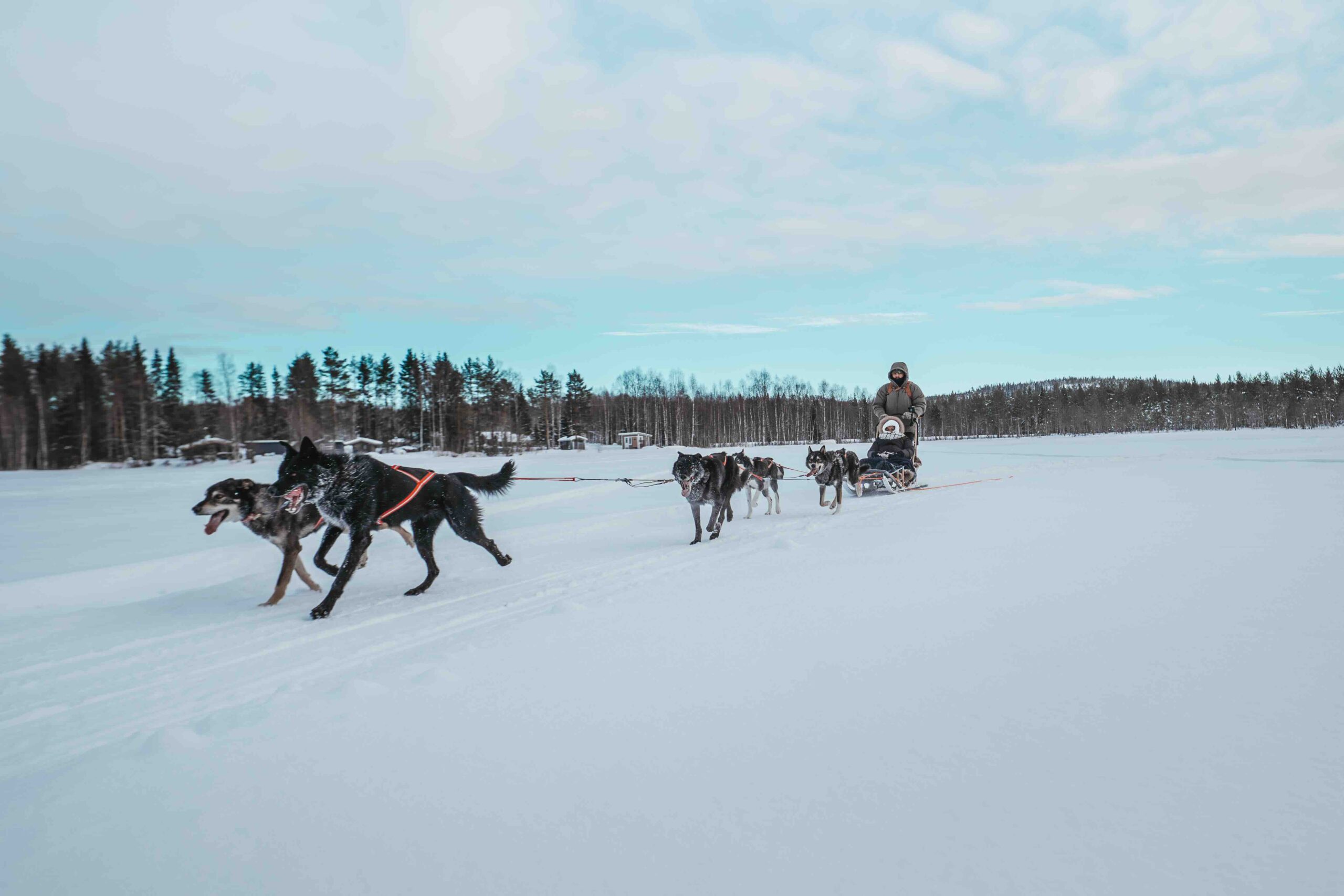
So how do you steer a dog sled?
There is no steering wheel, and the handlebar does not turn anything. Direction comes from three things working together:
- The dogs. The lead dogs follow the trail and the musher’s voice commands, and the gangline pulls the sled after them.
- The sled’s shape. The rocker in the runners gives the sled a pivot point, so it follows the team around bends instead of ploughing straight on.
- The driver. Your job is to keep your balance, keep the speed comfortable with the drag mat and brake, and help the sled through the curves as your musher shows you.
On a prepared trail, the dogs know the way far better than any first-time driver. What makes a good ride is mostly speed control: a team that is not rushing downhill and a driver who is relaxed on the runners. If you want to know the words the dogs listen to, read our article on musher commands, and for who runs where in the team, sled dog team positions.
How this shows up on our tours
On our Nulkki Husky Adventure you drive the sled yourself on a 5 km self-driving husky ride at Kuoksa, in the Kuoksajärvi forest. Our winter dog sledding at the Kuoksa Husky Park is organised together with the Tails Ahead Sleddogs kennel, from November until April.
Before you set off, the product page promises “detailed instructions on how to safely mush the huskies” and information about the dogs. That briefing is where the parts in this article become real: where to put your feet, when to use the brake and the mat, and what to do when the team stops. Which techniques a particular kennel prefers can vary, so the musher’s briefing on the day is what counts.
The tour is from 189 € and lasts 4 hours. Winter clothing (overalls, boots and gloves) is included, as are cookies and juice, and pick-up within a 10 km radius of Rovaniemi city centre. It is not suitable for children under 3, and children under 13 must be accompanied by adults paying the full price. In bad weather the ride can be arranged as a shortened guide-driven experience for safety, and the tour can be cancelled or rescheduled in extreme weather; the temperature limit is -35°C, and -25°C for small children.
If you would rather sit than drive, the Arctic Paws husky ride at Lapland Winter Park is guide-driven: you sit in the sleigh for about 2 km. And our Kuoksa Husky & Reindeer Adventure combines the same 5 km self-driven husky ride with a reindeer sleigh ride and salmon soup in a teepee.
Frequently asked questions
What are the main parts of a dog sled?
The runners, the stanchions that hold up the basket, the basket and its bed, the brush bow at the front, and the handlebar (driving bow) at the back. The brake, drag mat and snow hook control speed and anchor the team, and the gangline connects the dogs to the sled.
What is the difference between the brake and the drag mat?
The brake is a metal claw that digs into the snow when you stand on it, for slowing hard or stopping. The drag mat is a rectangular piece of rubber at the back of the sled that you use to control speed more gently.
What is a snow hook for?
A snow hook is a large metal hook attached to the gangline and driven into firm snow to anchor a team when it has stopped.
Do I steer the sled myself on the Nulkki Husky Adventure?
You drive the sled yourself on the 5 km ride, but the dogs follow the trail and the sled follows the dogs. Your job is balance and speed control, and our musher gives detailed instructions on how to safely mush the huskies before you start.
What are sled runners made of?
According to the University of Alaska Fairbanks terminology, runner bottoms are usually wood covered with a replaceable plastic or Teflon layer. The Iditarod’s education programme notes that mushers change runner plastics for different trail surfaces.
Is winter clothing included on the Nulkki Husky Adventure?
Yes. The product page lists winter clothing in adult and child sizes: overalls, boots and gloves.
Ready to book?
StayLapland · From 189 €
4 hours · Easy · Cut off: 12 hours before start time
Questions about driving a team? Email booking@staylapland.com or WhatsApp +358 40 128 7846.
You may also like
- Arctic Paws — 2 km Family-Friendly Husky Ride at Lapland Winter Park — from 59 €, approx. 10-minute ride
- Kuoksa Husky & Reindeer Adventure — from 349 €, 5 hours
Sources
- University of Alaska Fairbanks, Project Jukebox – Dog Mushing Terminology
- Iditarod Education – Friction, Sleds, and Why It’s Important to Get It Right
- Smithsonian National Museum of American History – Iditarod Dog Sled used by Libby Riddles