Guests who sit in our reindeer sleighs at Kuoksa often ask the same things: where are the reindeer in summer, why do some have antlers in winter and others not, and what is a round-up? The answers all come from one idea – reindeer herding follows the seasons of northern nature, and the herders’ calendar is built around the animals’ own year.
Below we walk through that year season by season, using the Finnish Reindeer Herders’ Association (Paliskuntain yhdistys) as our source for the herding facts, and our own experience at Kuoksa Reindeer Stories for how it looks on the farm.
In Finland the reindeer herding year runs from 1 June to 31 May. Calves are born from May, often into the snow, and are earmarked with their owner’s mark around midsummer. Autumn brings the rut and the round-ups, which run from the end of September to January. In winter reindeer dig through the snow for lichen, and herders feed them when conditions demand it. On our Kuoksa Reindeer Adventure (from 159 €, 3 hours) our guides tell this story beside the animals themselves.
At a glance
- From: 159 €
- Experience type: Reindeer tour
- Duration: 3 hours
- Difficulty: Very easy
- Book in Advance: Cut off: 12 hours before start time
- Included: 2-3 km reindeer safari in the forest of Lapland; Information about the life of reindeer, reindeer farm and reindeer herding in general; A Tour Guide in English (other languages available on request: (Spanish, Portuguese, French, Italian, German & Finnish. PLEASE NOTE LIMITED AVAILABILITY FOR OTHER LANGUAGES) If another language is required. Please send us an email or WhatsApp after booking.); Winter clothing (Adult & Child size), overalls, boots, gloves, socks; Cookies and juice; Photos taken with your own device; Pick-ups are included in the price within a 10 km radius of Rovaniemi city centre; Between 1 December and 10 January, drop-offs are included only to selected locations: Postmaster Hotel, Rovaniemi City Centre, Ollerovaara area and Santa Claus Village; Air conditioned car
- Cancellation: Free cancellation 24 hours before the activity. We will charge a cancellation fee of 100% if booking is cancelled less than 24 hours before the activity.
- Accessibility: Not wheelchair accessible; Not stroller accessible
StayLapland · From 159 €
3 hours · Very easy · Cut off: 12 hours before start time
Why the reindeer year starts on 1 June
According to the Reindeer Herders’ Association, the reindeer herding year begins on 1 June and ends on 31 May. The logic is simple: the year starts with a new generation. By June the calves of the spring have been born, and everything that follows – marking, the summer on pasture, the autumn round-ups, winter – is organised around them.
The association describes herding as following “the rhythm of the northern nature, and the natural annual cycle of reindeer”. The two busiest periods for herders are calf marking in June and July and the round-ups from the end of September to January.
A little background from our own reindeer information page: reindeer are semi-domesticated herd animals that spend most of their lives in the forests and fells. Reindeer husbandry is the oldest way of life still practised in Finland, and every reindeer in Finland has an owner who belongs to a reindeer herding cooperative.

Spring: calves in the snow
The Reindeer Herders’ Association quotes an old proverb, “Calf in the snow on First of May”: female reindeer start to calve during May, and the calving season may continue until the end of June. Most reindeer calve out in nature, moving to their calving areas on their own; some herders gather the females into fences and let them free after calving.
Reindeer milk is rich in nutrients and is the calves’ main food at first. The calves start growing antlers right away, and the mothers – who have carried their antlers all winter – drop them a few weeks after giving birth. When the snow crust is hard in spring, reindeer can eat lichens from the ground or beard moss from the trees.
Summer: calf marking and fattening up
Calf marking happens around midsummer and, according to the association, takes about 2–3 weeks depending on the weather. It is made easier by the insects: blood-sucking insects make reindeer gather together, so herds are easier to bring in by foot or ATV.
The work is usually done late in the evening and at night, when the air is cooler, to minimise stress for the animals. Calves are caught by hand or lasso, given a temporary number tag and released. Herders watch which female each calf follows, because a calf gets the same owner’s earmark as its mother. Then the calves are marked and returned to the summer pasture. Not every cooperative holds calf markings – elsewhere calves are marked in the home fence or during the autumn round-ups.
For the reindeer, summer is about eating. Both sexes grow new antlers and renew their fur, and they eat green plants and mushrooms to build fat for the winter. Our own reindeer page notes that reindeer eat over 400 different plants, mushrooms and lichen being favourites. Herders use the summer to maintain fences and collect hay and leafy branches for winter feed.
StayLapland · From 159 €
3,5 hours · Easy · Cut off: 8 hours before start time
Autumn: the rut and the round-ups
Autumn is when reindeer are in their best condition. The rut begins in September for the males, and the females follow a couple of weeks later; the Finnish word for the rut, rykimä, comes from the sound the males make. Male antlers are at their biggest and strongest now, and after the rut the males drop them and start growing new ones.
The rut actually helps the herders, because the males keep their groups of females tightly together. Round-ups are held in September and October in the southern and central herding areas, and further north after the waterways are covered with thick ice. Herds are gathered on foot, by motorbike, ATV and even helicopter. Inside the fence the animals are caught one by one, their earmarks are checked and they are “read” – counted in the books, which is legally required. A small cut in the fur on the side shows that an animal has already been counted.
The round-up is also when herders decide which animals stay in the herd for breeding or work and which go to slaughter. The association notes that around two million kilos of reindeer meat are produced in Finland each year, and that all parts of the reindeer are used where possible.
Winter: lichen under the snow
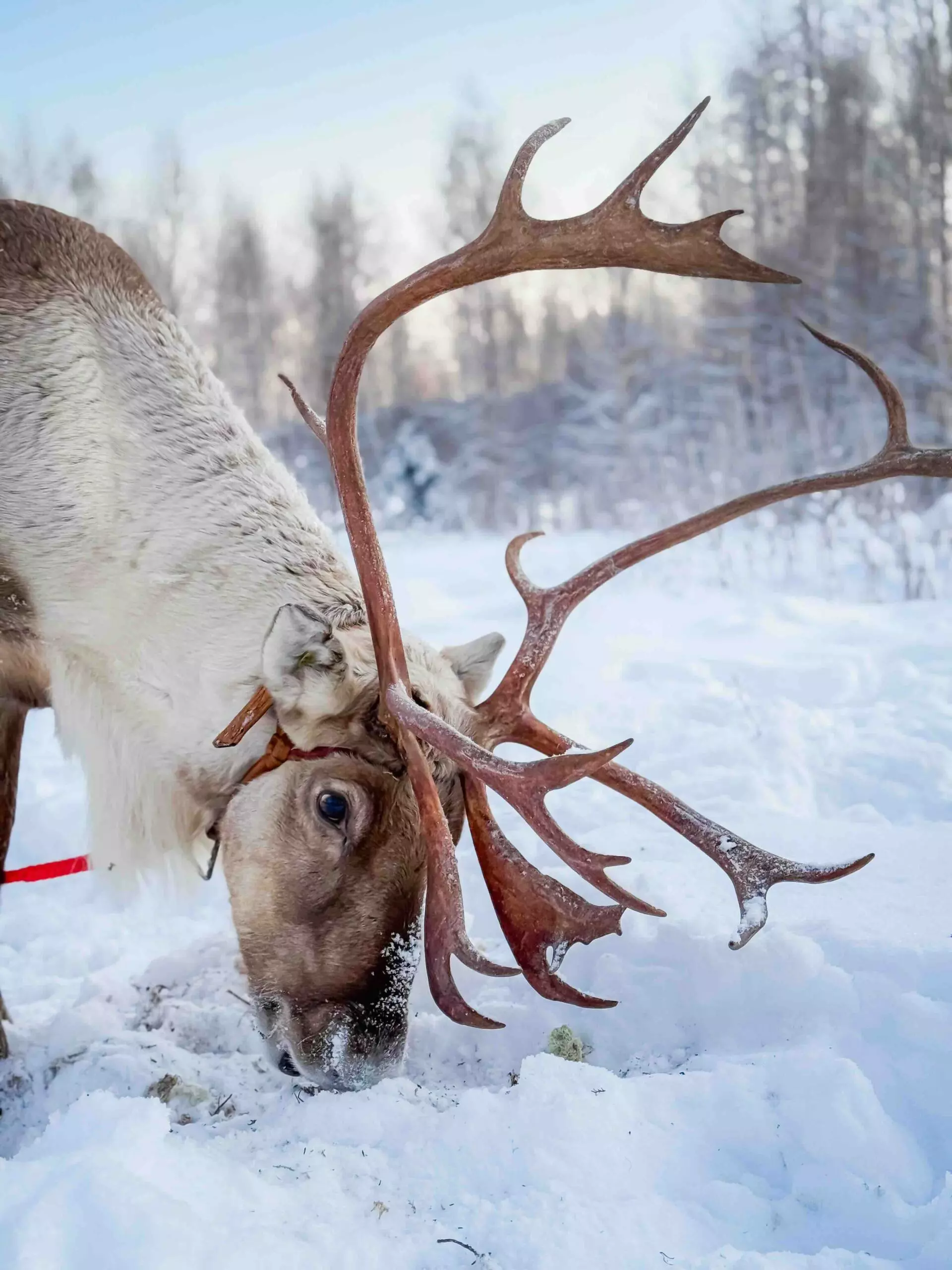
Winter is the hardest season. Reindeer grow a thick coat – our reindeer page notes it keeps them warm even at -50 °C – and they dig through the snow for food. Their favourite, lichen, contains easily digestible carbohydrates, and reindeer have an excellent sense of smell for finding it under deep snow. Their broad four-toed hooves are adapted both to walking in snow and to digging.
Female reindeer keep their antlers through the winter, which helps them defend their feeding spots and their calves; most are pregnant again by now. Herders keep an eye on the herds with snowmobiles, and GPS collars on a few animals can show where a whole herd is moving. Reindeer are fed in winter according to need and local conditions – the association points out that feeding matters especially where old lichen-rich forests have disappeared, and that it helps strong calves to be born in spring.
How this shows up on our tours
Our reindeer at Kuoksa Reindeer Stories live this same year. As our reindeer page explains, training starts when they are young, but they stay semi-domesticated and spend their summers with the main herd in the forest. Around the age of 4 or 5 they are ready to pull sleighs for visitors. During the working season each reindeer follows a work shift calendar so it gets the rest it needs, and between shifts the herd has spacious pens to roam in. Kuoksa Reindeer Stories has received the Green Activities certificate.
On the Kuoksa Reindeer Adventure you get a 2–3 km reindeer safari in the forest and information about the life of reindeer, the reindeer farm and reindeer herding in general – the season you visit in is part of the story. The same sleigh ride is built into Ice Fishing with Reindeer and, after dark, into our Northern Lights Tour Reindeer Safari. If the weather does not allow a sleigh ride, the tours are arranged as a reindeer walk instead.
For a fuller description of what a visit to our reindeer is like, read our article on the reindeer safari in Rovaniemi, or browse all our reindeer activities.
What visitors notice in each season
A few things you can look for yourself, based on the cycle above:
- Antlers in winter: a reindeer carrying antlers in mid-winter is most likely a female – the males dropped theirs after the autumn rut.
- The clicking sound: as our reindeer page describes, listen for the soft click from their joints when they walk – a sound that helps keep the herd together in the forest.
- Round-up season: from the end of September to January herders across the herding area are busy gathering, counting and sorting their reindeer.
- Thick coats: by the time our winter sleigh season is running, the reindeer are in their full winter fur.
Frequently asked questions
When does the reindeer herding year start?
In Finland the reindeer herding year runs from 1 June to 31 May, according to the Reindeer Herders’ Association.
When are reindeer calves born?
Females start to calve during May, and the calving season can continue until the end of June.
What is calf marking?
Around midsummer herders gather the herds and give each calf its owner’s earmark – the same mark as its mother. It takes about 2–3 weeks and is usually done at night when it is cooler.
When are reindeer round-ups held?
From the end of September to January. In the southern and central areas they are held in September–October; further north after the waterways freeze over with thick ice.
Why do some reindeer have antlers in winter?
Males drop their antlers after the autumn rut, while females keep theirs through winter and drop them a few weeks after calving in spring.
Where are StayLapland’s reindeer in summer?
Our reindeer are semi-domesticated and spend their summers with the main herd in the forest, as all reindeer in the herding area do.
Ready to book?
StayLapland · From 159 €
3 hours · Very easy · Cut off: 12 hours before start time
Questions about our reindeer or the tours? Email booking@staylapland.com or WhatsApp +358 40 128 7846.
You may also like
- Ice Fishing with Reindeer — from 159 €, 3,5 hours
- Northern Lights Tour Reindeer Safari — from 179 €, 3,5 hours
Sources
- Reindeer Herders’ Association – Reindeer husbandry year
- Reindeer Herders’ Association – Summer (calf marking)
- Reindeer Herders’ Association – Autumn (rut and round-ups)
- Reindeer Herders’ Association – Winter
- Reindeer Herders’ Association – Spring
- Reindeer Herders’ Association – A year of a reindeer