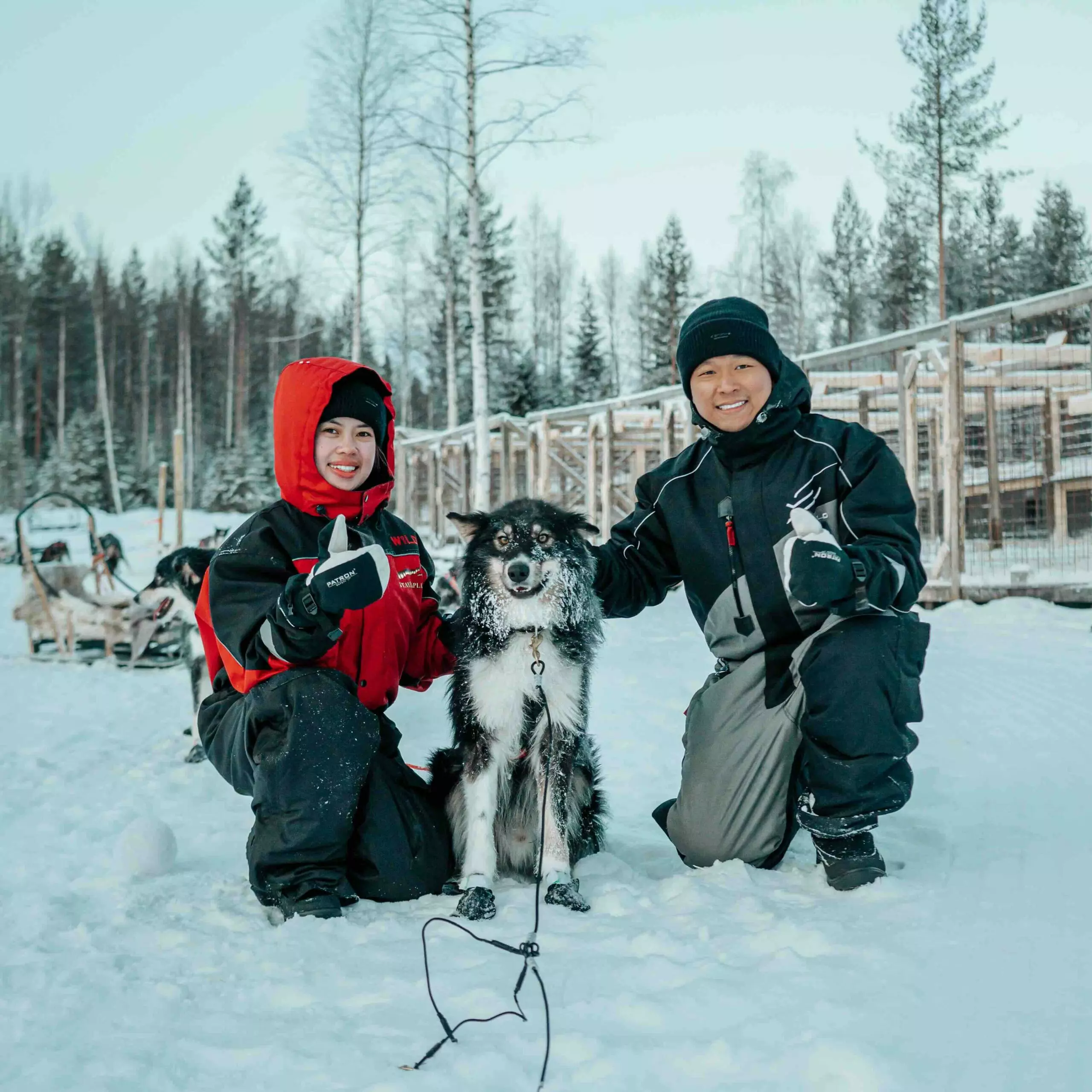
“Are these Siberian huskies?” is a natural question when you first meet a sled team. The honest answer is more interesting than a yes or no. Alongside the Siberian husky, the sled-dog world relies on the Alaskan husky – a working type of dog bred for one job, pulling a sled, rather than for a particular look.
At Kuoksa Husky Park our husky tours run with real working dogs – Alaskan and Siberian huskies trained and raised for mushing. So here is what an Alaskan husky sled dog actually is, where it comes from, what genetic research has found, and what that means when you stand on the runners of one of our sleds.
In short: an Alaskan husky sled dog is a mixed-ancestry working dog selected for speed, endurance and the will to run, not a breed with a written appearance standard. A 2010 study led by researchers at the US National Human Genome Research Institute found that Alaskan sled dogs nevertheless carry their own genetic signature, drawing on Alaskan malamute and Siberian husky for endurance, pointer breeds and the saluki for speed, and the Anatolian shepherd for work ethic. The Siberian husky, by contrast, is a registered breed with an official standard.
At a glance
- From: 189 €
- Experience type: Husky tour
- Duration: 4 hours
- Difficulty: Easy
- Book in Advance: Cut off: 12 hours before start time
- Included: A Husky Ride 5 Km (Self-driving); Detailed instructions on how to safely mush the Huskies; Information about Huskies; Photos taken with your own device; A Tour Guide in English (other languages available on request: (Spanish, Portuguese, French, Italian, German & Finnish. PLEASE NOTE LIMITED AVAILABILITY FOR OTHER LANGUAGES) If another language is required. Please send us an email or WhatsApp after booking.); Winter clothing (Adult & Child size), overalls, boots & gloves; Cookies and juice; Pick-ups are included in the price within a 10 km radius of Rovaniemi city centre; Between 1 December and 10 January, drop-offs are included only to selected locations: Postmaster Hotel, Rovaniemi City Centre, Ollerovaara area and Santa Claus Village
- Cancellation: Free cancellation 24 hours before the activity. We will charge a cancellation fee of 100% if booking is cancelled less than 24 hours before the activity.
- Accessibility: Not wheelchair accessible; Not stroller accessible
StayLapland · From 189 €
4 hours · Easy · Cut off: 12 hours before start time
#bokun_3f4ce40e_b0d0_cac8_b0f0_9b4ec4f4edb7 { display: inline-block; padding: 10px 20px; background: #408C3D; border-radius: 5px; box-shadow: none; font-weight: 600; font-size: 16px; text-decoration: none; text-align: center; color: #FFFFFF; border:none; cursor: pointer; transition: background .2s ease; } #bokun_3f4ce40e_b0d0_cac8_b0f0_9b4ec4f4edb7:hover{ background: #285726; } #bokun_3f4ce40e_b0d0_cac8_b0f0_9b4ec4f4edb7:active{ background: #30682e; }A type, not a breed
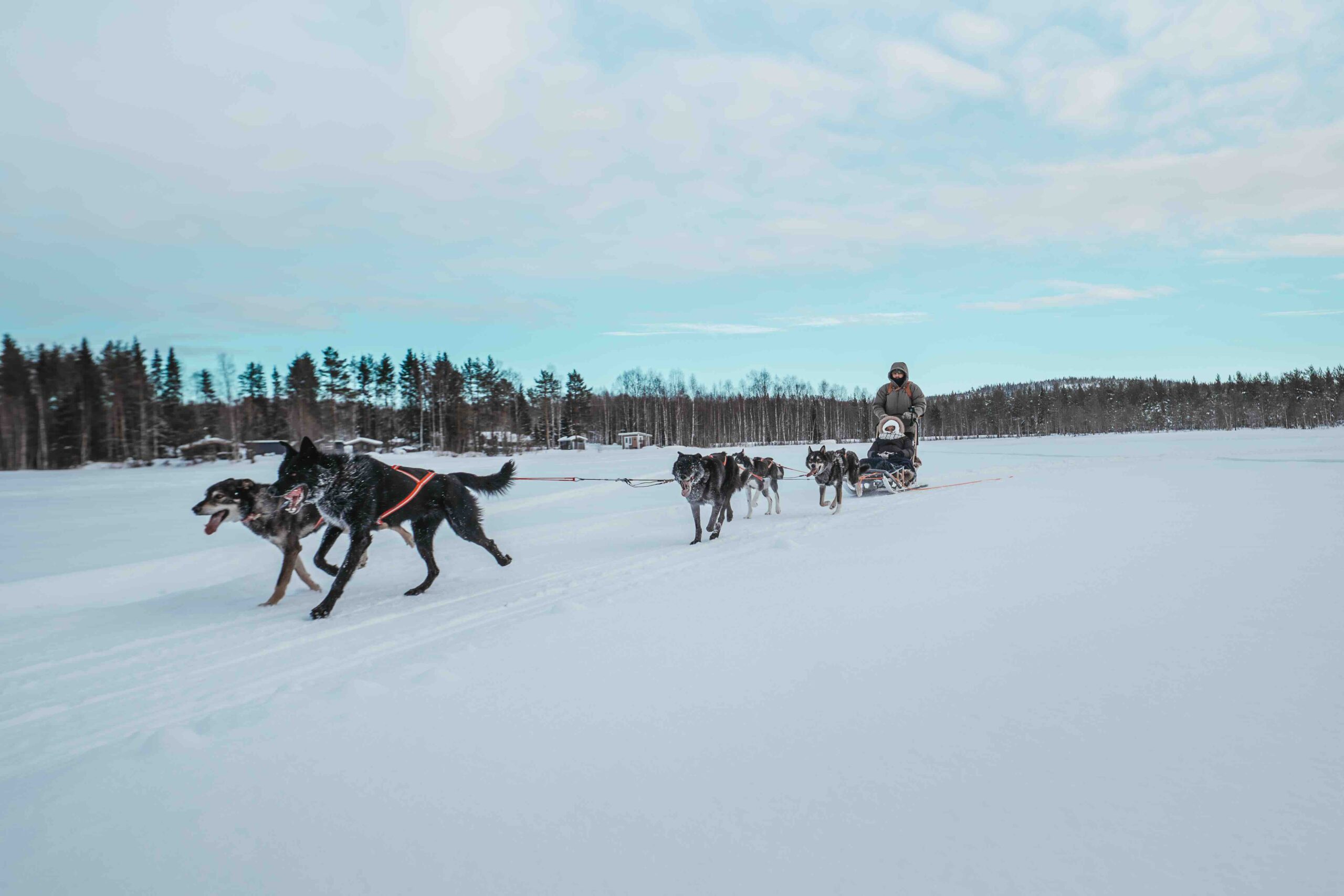
Kennel clubs recognise breeds by pedigree and by a written standard describing how the dog should look. The Alaskan husky has neither. Mushers breed it purely on performance: how fast a dog runs, how long it keeps going, how well it eats and recovers, and how keen it is to pull. The result is a dog whose appearance varies a great deal – short coats and long coats, pricked ears and folded ears, every colour you can think of.
According to the US National Human Genome Research Institute (NHGRI), the Alaskan sled dog was developed through “selection and breeding of individuals based solely on their athletic prowess”. Looks were simply never the goal.
What the genes say
In 2010, a team led by Heather Huson – then a PhD candidate at the University of Alaska Fairbanks working at NHGRI – published a study in BMC Genetics that compared 199 Alaskan sled dogs with 141 other breeds. Even though the Alaskan husky is not a registered breed, the dogs shared a distinct genetic signature.
- Endurance was linked to Alaskan malamute and Siberian husky ancestry.
- Speed was linked to the English pointer, German shorthaired pointer and saluki.
- Work ethic was linked to the Anatolian shepherd.
The researchers also found that the genetic profile was enough to tell apart dogs bred for sprint racing from dogs bred for distance.
The Siberian husky: the registered breed
The Siberian husky is the dog most people picture when they hear the word “husky”. Unlike the Alaskan husky, it is a formally recognised breed. The Fédération Cynologique Internationale (FCI) lists it in Group 5, Spitz and primitive types, in the Nordic sledge dogs section. The FCI gives the United States of America as the breed’s country of origin and accepted the breed on a definitive basis in 1966.
Because a breed standard describes appearance as well as working ability, Siberians look much more alike than Alaskan huskies do.
StayLapland · From 349 €
Kuoksa Husky & Reindeer Adventure
5 hours · Easy · Cut off: 1 day before start time
#bokun_fbfdb85d_1291_717f_695d_3db7b5f352bd { display: inline-block; padding: 10px 20px; background: #408C3D; border-radius: 5px; box-shadow: none; font-weight: 600; font-size: 16px; text-decoration: none; text-align: center; color: #FFFFFF; border:none; cursor: pointer; transition: background .2s ease; } #bokun_fbfdb85d_1291_717f_695d_3db7b5f352bd:hover{ background: #285726; } #bokun_fbfdb85d_1291_717f_695d_3db7b5f352bd:active{ background: #30682e; }Two old lineages from the Siberian Arctic
Newer research has pushed the story of sled dogs much further back. In September 2024, a study in Genome Biology and Evolution co-led by Heather Huson and Tracy Smith at Cornell University analysed 344 dogs – mostly registered Siberian huskies, but also Alaskan malamutes, Alaskan sled dogs, Chukotka sled dogs and several European breeds.
The team found two distinct lineages of Arctic dogs rather than one, and concluded that sled dogs originated in the northeastern Siberian Arctic at the end of the Pleistocene, which ended roughly 11,700 years ago. The study also found gene flow from European breeds into Siberian huskies, with about half of racing Siberians showing that mixture – a sign that Alaskan huskies, themselves a mix of European and Arctic ancestry, have contributed to the Siberian line and not only the other way round.
Who looks after our dogs
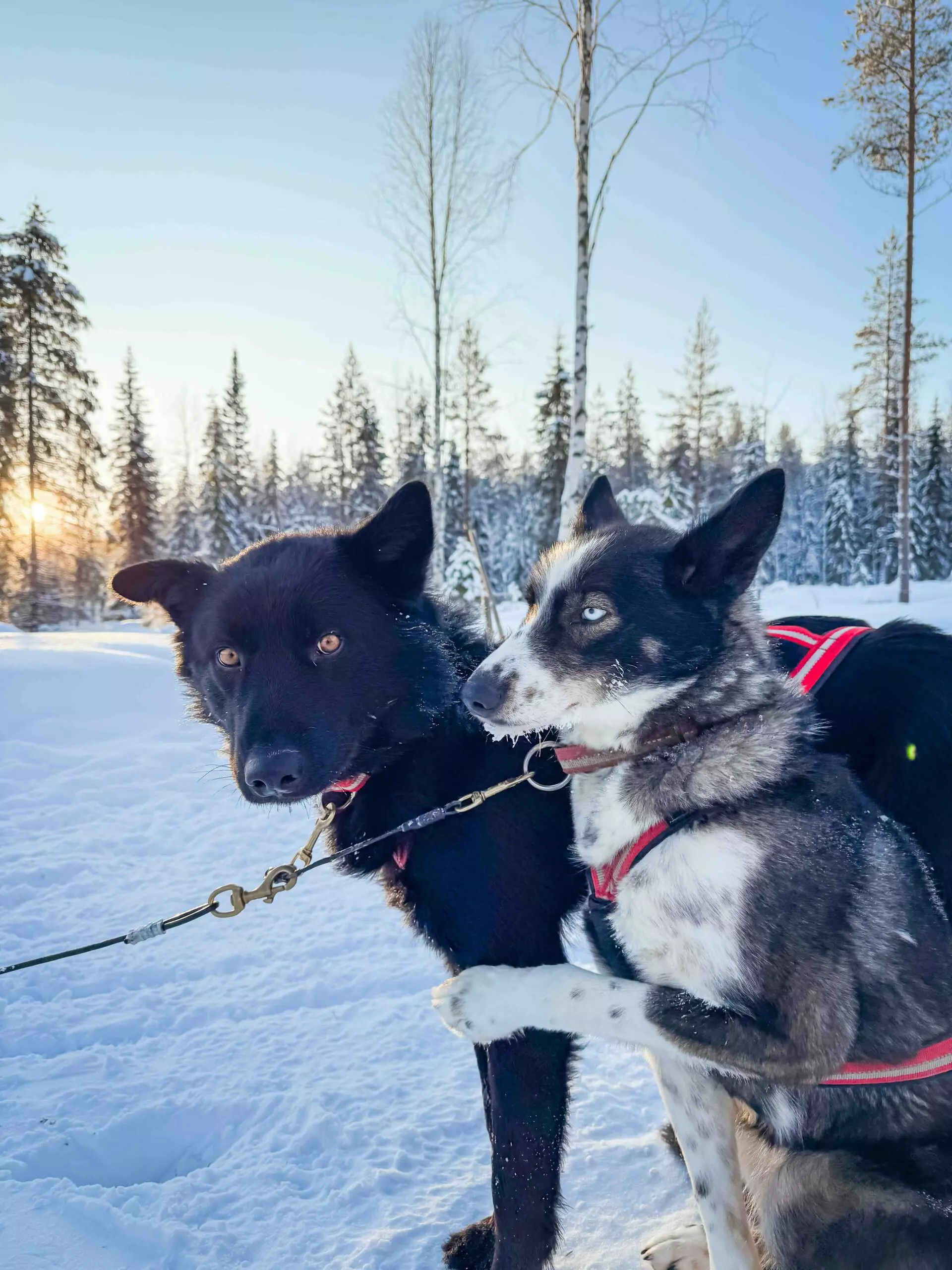
The dog sledding tours at Kuoksa Husky Park are organised together with our partners Bent and Delia of the kennel Tails Ahead Sleddogs, based in Taivalkoski. Bent has more than fifteen years of experience working with sled dogs. Delia trained as a veterinary technician, worked at the Animal University Hospital in Zürich and keeps up to date with books and veterinary seminars on sled dogs. Together they run the tours at Kuoksa from November until April.
In their words on our Kuoksa Husky Park story page: “There are as many different ways of raising, training and feeding sled dogs as there are kennels.” What they aim for is a well-trained, well-cared-for team that is confident doing what it loves – and the dogs’ health, rest and happiness come first.
How this shows up on our tours
You do not need to remember any of the genetics to enjoy a ride, but you will see it in action. On the Nulkki Husky Adventure (from 189 €, 4 hours) you drive your own sled on a 5 km trail through the Kuoksajärvi forest after detailed instructions from the musher on how to mush the huskies safely. You also get information about the dogs, cookies and juice, and time to take photos with your own device.
If you would like to combine the dogs with reindeer, the Kuoksa Husky & Reindeer Adventure (from 349 €, 5 hours) takes you to the wilderness by the frozen lake – our reindeer safari guide explains the reindeer side of the day. For younger families there is Arctic Paws (from 59 €), a gentle 2 km husky sleigh ride at Lapland Winter Park followed by time to meet the dogs and take photos. Our guide to husky tours in Rovaniemi brings all of them together.
Weather, age limits and the small print
Cold is part of the job, but we set limits for our guests. On the Nulkki Husky Adventure the temperature limit is −35 °C, and −25 °C for small children, for safety reasons. In bad weather the tour can be arranged as a shortened, guide-driven experience. The tour is not suitable for children under 3, and children under 13 must be accompanied by adults paying the full price. At least 2 people are required for the tour to run on weekdays and Saturdays, and at least 4 on Sundays and public holidays.
Winter clothing – overalls, boots and gloves in adult and child sizes – is included, as is pick-up within a 10 km radius of Rovaniemi city centre. Free cancellation applies up to 24 hours before the activity; after that the cancellation fee is 100%.
Frequently asked questions
Is the Alaskan husky a real breed?
Not in the kennel-club sense. It has no official breed standard; mushers breed it for performance. Genetic research published in 2010 did find that Alaskan sled dogs share a distinct genetic signature.
What is the difference between an Alaskan husky and a Siberian husky?
The Siberian husky is a registered breed with a written standard (FCI Group 5, Nordic sledge dogs). The Alaskan husky is a working type bred only for sled performance, with Siberian husky and malamute ancestry mixed with pointer, saluki and other breeds.
What kind of dogs will I meet at Kuoksa Husky Park?
Our husky tours run with real working dogs – Alaskan and Siberian huskies trained and raised for mushing by our partners at Tails Ahead Sleddogs.
Do I drive the sled myself?
On the Nulkki Husky Adventure, yes: the 5 km ride is self-driven after detailed instructions from the musher. In bad weather the tour can be arranged as a shortened guide-driven experience.
When do your husky tours run?
The dog sledding tours at Kuoksa Husky Park run from November until April, depending on snow.
Is there a minimum age?
The Nulkki Husky Adventure is not suitable for children under 3 years old, and children under 13 must be accompanied by adults paying the full price.
Ready to book?
StayLapland · From 189 €
4 hours · Easy · Cut off: 12 hours before start time
#bokun_ead0af3a_69e9_3029_f53f_927967d36d4a { display: inline-block; padding: 10px 20px; background: #408C3D; border-radius: 5px; box-shadow: none; font-weight: 600; font-size: 16px; text-decoration: none; text-align: center; color: #FFFFFF; border:none; cursor: pointer; transition: background .2s ease; } #bokun_ead0af3a_69e9_3029_f53f_927967d36d4a:hover{ background: #285726; } #bokun_ead0af3a_69e9_3029_f53f_927967d36d4a:active{ background: #30682e; } #bokun_44ce92ed_0219_8b2e_2ef5_5dcc5609e93b { display: inline-block; padding: 10px 20px; background: #408C3D; border-radius: 5px; box-shadow: none; font-weight: 600; font-size: 16px; text-decoration: none; text-align: center; color: #FFFFFF; border:none; cursor: pointer; transition: background .2s ease; } #bokun_44ce92ed_0219_8b2e_2ef5_5dcc5609e93b:hover{ background: #285726; } #bokun_44ce92ed_0219_8b2e_2ef5_5dcc5609e93b:active{ background: #30682e; }Want to meet the dogs? Email booking@staylapland.com or WhatsApp +358 40 128 7846 and we will help you pick the right husky tour.
You may also like
- Kuoksa Husky & Reindeer Adventure — from 349 €, 5 hours
Sources
- NHGRI – The Alaskan sled dog: a genetic breed apart (2010)
- Huson et al. (2010), A genetic dissection of breed composition and performance enhancement in the Alaskan sled dog, BMC Genetics (PMC)
- Cornell Chronicle – Genomics reveals sled dogs’ Siberian lineage (2024)
- FCI – Siberian Husky breed nomenclature (standard no. 270)