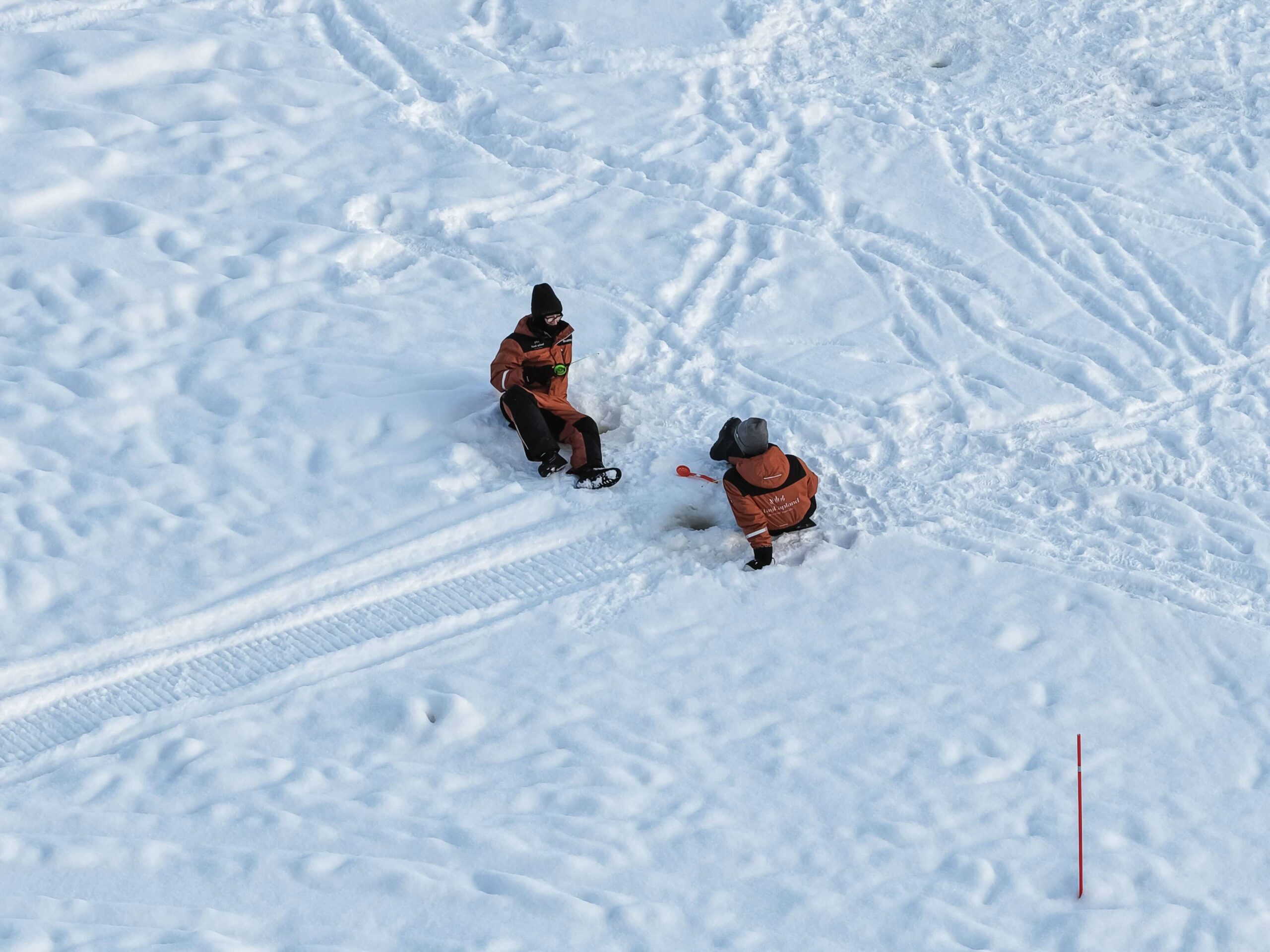
From October onwards we hear one question more and more: when do the lakes freeze around Rovaniemi? Some guests want to walk on a frozen lake, others want to try ice fishing, and many simply want to know what the landscape will look like when they arrive.
There is no single date – every lake, and every autumn, is different. But Finland has measured its lake ice for almost two centuries, and the research gives a clear picture. Below we summarise what the Finnish Environment Institute (SYKE), the national water service Vesi.fi and lake-ice research from the University of Helsinki say, and then explain how the ice shapes our own ice fishing season. All figures come from the sources listed at the end.
The short answer: according to Finnish lake-ice research, freeze-up in Lapland begins on some small lakes in late October, while the largest open areas of Lake Inari freeze at the end of November on average. Big, deep lakes can freeze up to a month later than small, shallow ones nearby. In Lapland the lakes then stay frozen for a long time – the mean ice-cover duration in 1961–2000 was over 220 days. We open our Ice Fishing at Private Kuoksa lake tour (from 89 €, 3,5 hours) when the ice allows, and the booking calendar shows the real dates.
At a glance
- From: 89 €
- Experience type: Ice Fishing tour
- Duration: 3,5 hours
- Difficulty: Easy
- Book in Advance: Cut off: 12 hours before start time
- Included: To give you the best possible experience we will provide you with thermal winter overalls, winter boots, as well as cozy beanies and mittens, which all come in both adult and children’s sizes.; A Guide in English (other languages available on request: Spanish, Catalan, Portuguese, French, Italian, German & Finnish. PLEASE NOTE LIMITED AVAILABILITY FOR OTHER LANGUAGES). If another language is required. Please send us email or WhatsApp after booking; Ice fishing equipment; Detailed instructions on how to use the Ice fishing equipment; Pick -ups and Drop -offs are included in the price in 10 km radius from Rovaniemi city centre; Air conditioned car; Photos taken with your own device; Local Snacks & Drinks
- Cancellation: Free cancellation 24 hours before the activity. We will charge a cancellation fee of 100% if booking is cancelled less than 24 hours before the activity.
- Accessibility: Not wheelchair accessible; Not stroller accessible
StayLapland · From 89 €
Ice Fishing at Private Kuoksa lake
3,5 hours · Easy · Cut off: 12 hours before start time
Book Early the Activities for Winter 2026–2027 – Save 10% with code EARLY27 01.11.2026–31.03.2027 (Excludes husky & reindeer tours)
Freeze-up in Lapland, in numbers
Johanna Korhonen’s doctoral dissertation on Finland’s winter and spring hydrology (University of Helsinki, 2019), which draws on SYKE’s long observation series, gives these reference points:
- Small lakes in Lapland: freeze-up occurs on some small lakes in late October.
- Big open lakes: the largest open areas of Lake Inari freeze up at the end of November on average.
- Southern coastal areas: lake freeze-up typically occurs at the beginning of December.
- Size matters: large, deep lakes in a given area can freeze as much as a month later than small, shallow ones.
The same work notes that the freeze-up date varies more in the south of Finland than in the north. Rovaniemi lies in southern Lapland, so treat these as regional reference points rather than a promise for any single lake or any single year.
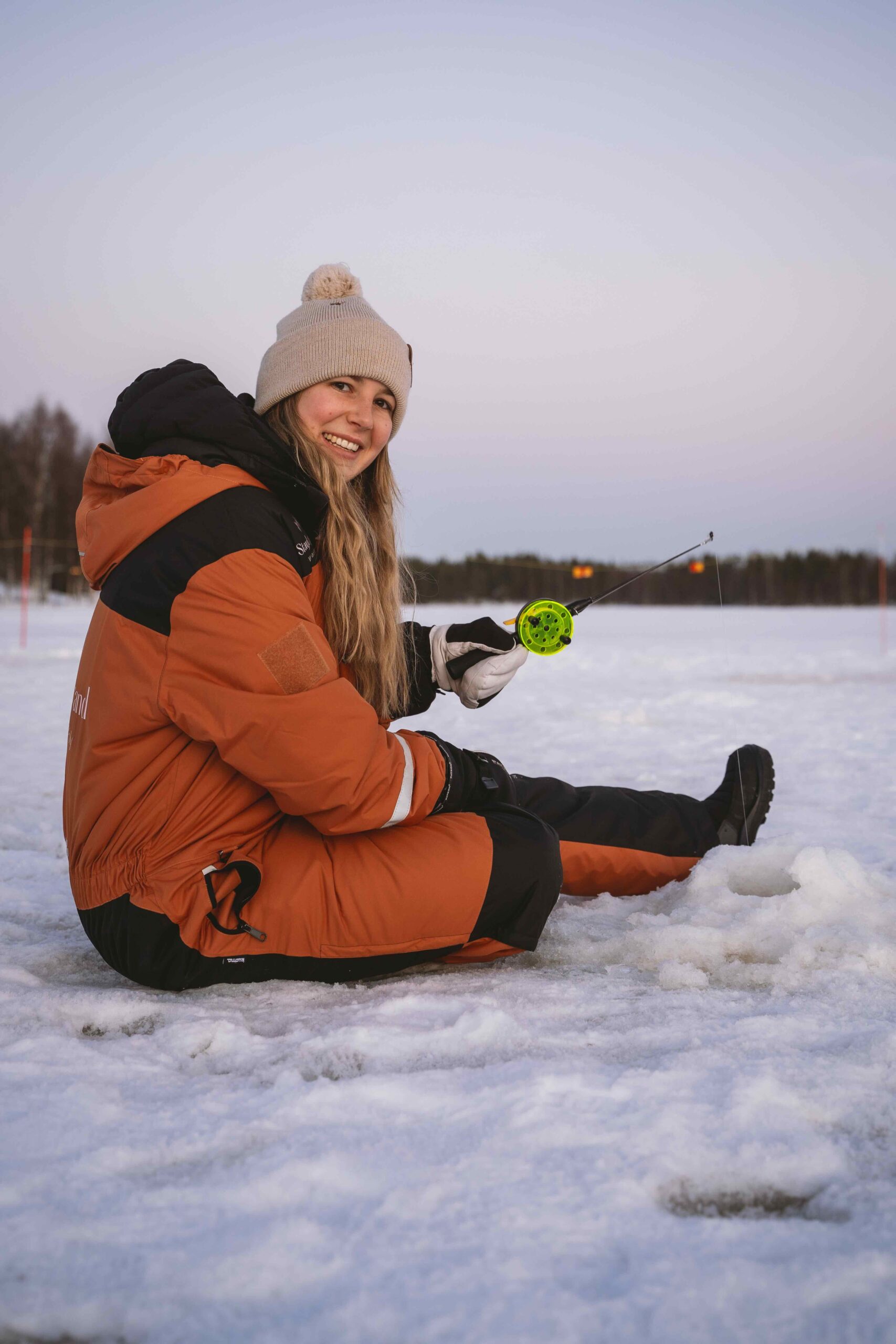
How a lake actually freezes
A lake does not freeze the moment the air drops below zero. First the whole water body has to cool. In autumn the surface water cools and sinks, mixing the lake, until the whole water body has cooled to 4 °C – the temperature at which fresh water is densest. After that the layers turn the other way round: colder, lighter water stays on top.
According to the dissertation, the first thin layer of ice crystals can form when the surface layer has cooled to freezing point, the air temperature is below zero and the wind is weak or calm.
Vesi.fi describes the order in which a lake freezes: shores and bays first, then open water, deep areas and flowing water last. Once the ice has formed, it can grow quickly – Vesi.fi gives about 2 cm a day when the air temperature is around −10 °C.
Clear ice and snow ice
Finnish has two everyday words for lake ice, and the difference matters to anyone who goes out on it.
- Teräsjää (“steel ice”) is clear ice that forms directly from freezing water. It is transparent and strong.
- Kohvajää is snow ice: it forms when water rises onto the ice and soaks the snow, and the slush freezes. According to Vesi.fi, its bearing capacity is only about half that of clear ice.
In Lapland heavy snow on the ice is common. Korhonen’s earlier research on Finnish lakes linked increases in ice thickness to heavy snow on the ice and the production of snow ice – so a thick sheet of ice is not automatically a strong one. We go through the official safety thresholds in our article on how thick ice must be in Finland.
StayLapland · From 159 €
3,5 hours · Easy · Cut off: 8 hours before start time
How long the ice lasts, and how thick it gets
Once Lapland’s lakes have frozen, they stay frozen for most of the year. For the period 1961–2000 the dissertation reports:
- Ice-cover duration: from under 140 days on the southern coast to over 220 days in Lapland.
- Maximum ice thickness: from below 50 cm in southern Finland to mainly 70–80 cm in Lapland; at Lake Kilpisjärvi in the north-western corner of Finland the mean maximum is almost 90 cm.
- Break-up: usually at the end of April in southern Finland, progressing north so that in northern Lapland the lakes usually melt at the beginning of June.
So the ice that begins as a thin skin in late autumn becomes, by late winter, a thick platform that people in Lapland walk, ski and fish on for months.
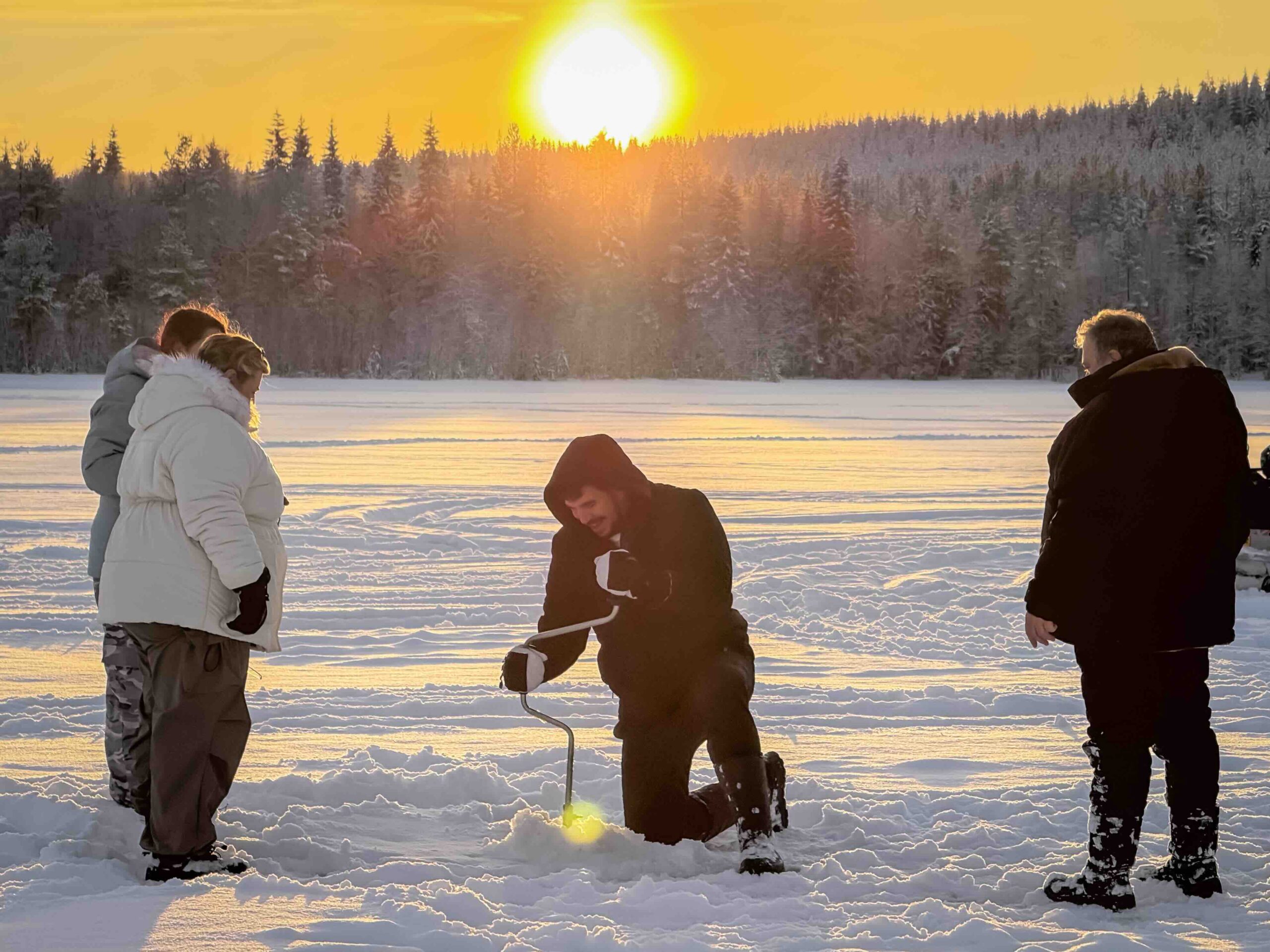
How Finland measures its lake ice
These figures exist because Finland has watched its lakes for a very long time. According to SYKE, the break-up record for Lake Kallavesi begins in 1822, its freeze-up record in 1833 and its ice-thickness record in 1909; Lake Oulujärvi has been observed since the winter of 1854–1855.
Today, Vesi.fi explains, SYKE coordinates ice-thickness observations at around 46–47 stations across Finland. Ice is measured roughly on the 10th, 20th and 30th day of each month, usually at least 50 metres from the shore. Each measurement records the total ice thickness, the clear ice, the snow ice and any water layer, as well as the snow depth.
You can follow the current situation on Vesi.fi’s ice-situation page.
Is freeze-up getting later?
The long series show a change. SYKE reports that between 1833 and 2009 the freeze-up of Lake Kallavesi moved 15 days later and its break-up 12 days earlier; at Lake Oulujärvi, over 156 winters, freeze-up moved nine days later and break-up eleven days earlier.
Korhonen’s 2006 study of almost ninety Finnish lakes found a significant trend towards earlier break-up everywhere except the very north, and a trend towards later freeze-up and shorter ice cover in the longest series. In other words, the far north has changed less than the south – but autumn ice is less predictable than it used to be, which is one more reason not to plan around a fixed date.
How this shows up on our tours
All of our ice fishing tours depend on the lake, not on the calendar. We do not publish a fixed opening date for them; instead, the booking calendar on each tour page shows the dates we actually run, as we explain in our winter 2026–2027 opening dates article.
Our classic trip is Ice Fishing at Private Kuoksa lake: from 89 €, 3,5 hours, rated easy. Your guide dresses you warmly from head to toe with thermal winter overalls, winter boots, beanies and mittens in adult and children’s sizes, prepares the ice fishing equipment and shows you how to use it. Local snacks and drinks are included, as are pick-ups and drop-offs within 10 km of Rovaniemi city centre. The product page also states that the tour may be cancelled or rescheduled in extreme weather conditions.
If you would like more than fishing, the same idea comes with a reindeer sleigh ride on Ice Fishing with Reindeer (from 159 €, 3,5 hours) or with about an hour of snowmobile driving on Ice Fishing with Snowmobiles (from 149 €, 5 hours). We compare the three in our ice fishing tours overview.
Frequently asked questions
When do lakes freeze around Rovaniemi?
Finnish lake-ice research gives late October for freeze-up on some small lakes in Lapland and the end of November on average for the largest open areas of Lake Inari. Every lake and every year is different; large, deep lakes can freeze up to a month later than small, shallow ones.
Which parts of a lake freeze first?
According to Vesi.fi, shores and bays freeze first, and open water, deep areas and flowing water freeze last.
How fast does lake ice grow?
Vesi.fi gives about 2 cm a day when the air temperature is around −10 °C.
How thick does lake ice get in Lapland?
For 1961–2000 the mean maximum ice thickness was mainly 70–80 cm in Lapland, and almost 90 cm at Lake Kilpisjärvi.
When does the ice melt in Lapland?
In northern Lapland lakes usually melt at the beginning of June; in southern Finland break-up is usually at the end of April.
When does your ice fishing season start?
When the lake ice allows. The booking calendar on each ice fishing tour page shows the dates we run; if a date is not shown, it is not bookable yet. You are welcome to ask us at booking@staylapland.com.
Ready to book?
StayLapland · From 89 €
Ice Fishing at Private Kuoksa lake
3,5 hours · Easy · Cut off: 12 hours before start time
Book Early the Activities for Winter 2026–2027 – Save 10% with code EARLY27 01.11.2026–31.03.2027 (Excludes husky & reindeer tours)
Questions about ice conditions or dates? Write to booking@staylapland.com or send us a WhatsApp message at +358 40 128 7846.
You may also like
- Ice Fishing with Reindeer — from 159 €, 3,5 hours
- Ice Fishing with Snowmobiles — from 149 €, 5 hours
Sources
- Vesi.fi (Finnish Environment Institute SYKE) – Jäätilanne / ice situation
- Finnish Environment Institute (SYKE) – Lake ice in Finland: observed trends
- Korhonen, J. (2019): Long-term changes and variability of the winter and spring season hydrological regime in Finland. University of Helsinki
- Korhonen, J. (2006): Long-term changes in lake ice cover in Finland. Hydrology Research 37 (4–5)