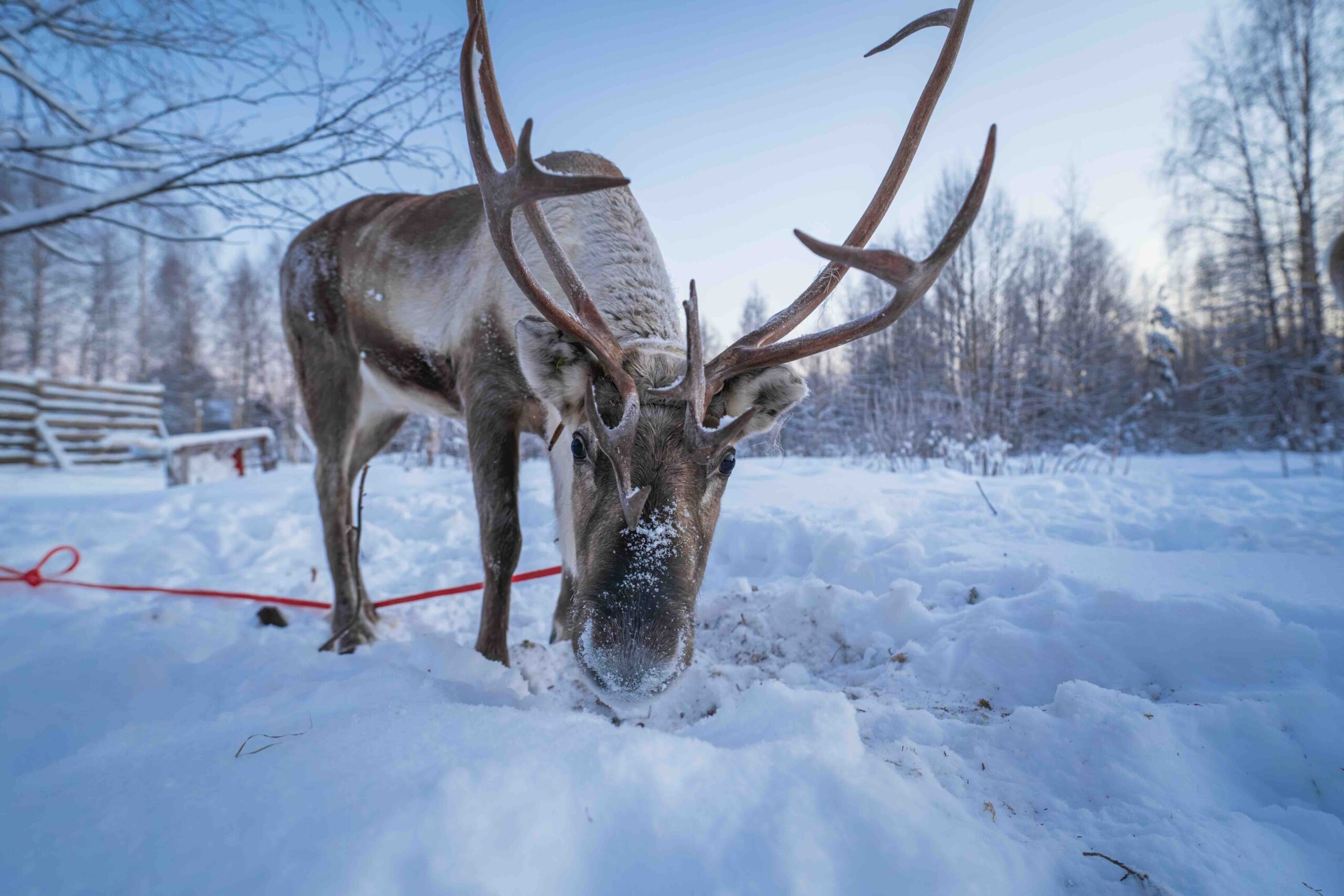
Guests who walk beside our reindeer at Kuoksa often stop and ask the same question: what is that clicking? It is a quiet, regular tick-tick that comes from the legs, not the mouth, and it follows the herd wherever it walks.
We hear it every working day, so we wanted to write down what is actually known about it, using university and peer-reviewed sources rather than folklore. Some of the answer is settled; some of it, perhaps surprisingly, is still an open question for science.
In short: the reindeer clicking sound is made by the legs while the animal walks. The University of Alaska Fairbanks Cooperative Extension explains that it comes from tendons in the reindeer’s feet slipping over the bones. Researchers generally link the sound to keeping the herd together, as our own reindeer information page describes, but the exact anatomical mechanism has not been fully pinned down: a 2022 study in Scientific Reports concluded that it “remains cryptic”.
At a glance
- From: 159 €
- Experience type: Reindeer tour
- Duration: 3 hours
- Difficulty: Very easy
- Book in Advance: Cut off: 12 hours before start time
- Included: 2-3 km reindeer safari in the forest of Lapland; Information about the life of reindeer, reindeer farm and reindeer herding in general; A Tour Guide in English (other languages available on request: (Spanish, Portuguese, French, Italian, German & Finnish. PLEASE NOTE LIMITED AVAILABILITY FOR OTHER LANGUAGES) If another language is required. Please send us an email or WhatsApp after booking.); Winter clothing (Adult & Child size), overalls, boots, gloves, socks; Cookies and juice; Photos taken with your own device; Pick-ups are included in the price within a 10 km radius of Rovaniemi city centre; Between 1 December and 10 January, drop-offs are included only to selected locations: Postmaster Hotel, Rovaniemi City Centre, Ollerovaara area and Santa Claus Village; Air conditioned car
- Cancellation: Free cancellation 24 hours before the activity. We will charge a cancellation fee of 100% if booking is cancelled less than 24 hours before the activity.
- Accessibility: Not wheelchair accessible; Not stroller accessible
StayLapland · From 159 €
3 hours · Very easy · Cut off: 12 hours before start time
What the click sounds like
The sound is a dry, soft click, a little like a knuckle being cracked, repeated with each step. One reindeer on its own is easy to miss. A group walking together through quiet, snowy forest is a different story: the clicks overlap into a steady rhythm that you can hear before you see the animals between the trees.
It happens while the reindeer is walking, not when it is standing still or lying down resting. That link to movement is the first clue to where it comes from.
Where the sound comes from
The simplest explanation comes from the University of Alaska Fairbanks Cooperative Extension, which works with reindeer herders in Alaska: “The clicking sound comes from tendons in the reindeer’s feet slipping over the bones.” As the leg moves, a tendon passes over bone and releases with a small audible snap.
Reindeer legs and feet are built for snow. The Finnish Reindeer Herders’ Association (Paliskuntain yhdistys) notes that the claws of the reindeer’s hoof are long, wide and crescent-shaped, and that a standing reindeer puts only 85–100 grams of pressure on each square centimetre of ground. The tendons that manage those wide, spreading hooves are the ones associated with the click.
What science still does not know
Here the honest answer gets more interesting. In 2022, a team of anatomists published a study in Scientific Reports looking at a small opening in the fibrous cuff around the flexor tendons of the forelimb, in 25 species of even-toed hoofed mammals from four families. They hoped it might explain why some deer and antelope click and others do not.
It did not. The structure was found in 24 of the 25 species, clickers and non-clickers alike, and the authors concluded that “the mechanism responsible for this sound remains cryptic from the present anatomical perspective”. In other words, we know roughly where the click comes from and what triggers it, but not the exact anatomical reason reindeer click so clearly while many related animals are silent.
StayLapland · From 159 €
3,5 hours · Easy · Cut off: 8 hours before start time
Why it may matter: a herd you can hear
Reindeer are herd animals. As our reindeer information page puts it, when they walk you can hear “the soft click from their joints, a sound that helps keep the herd together in the forest”. In dark winter forest, in falling snow, or during the long polar night, a sound that tells each animal where the others are is useful.
There is also a clue from Africa. In 2008, researchers from the University of Copenhagen and the Zoological Society of London studied knee-clicks in eland antelopes, published in BMC Biology. They found that the pitch of the click was lower in larger bulls, so the sound honestly advertised body size. The same paper mentions that reindeer produce similar clicks, but states that “the function of the clicks in this species remains to be investigated”. So the body-size idea is well supported in eland; for reindeer it is still a hypothesis.
Reindeer, snow and the year around the click
The click is only one of the ways reindeer are adapted to the north. Our reindeer information page describes how their four-toed hooves are made for walking in thick snow and digging for food, how their excellent sense of smell lets them find lichen under the snow, and how they grow thick winter fur for extreme cold.
The herders’ year follows the animals, from calving in spring to the autumn round-up. If you want to know more about that side of reindeer life, our post on the reindeer roundup in Finland explains the autumn erotus.
Semi-domesticated, still a herd
Our reindeer are working animals, but they have not stopped being herd animals. As we explain on our reindeer information page, reindeer are semi-domesticated: even trained reindeer spend their summers with the main herd in the forest. Training starts young, so that calves become comfortable with people, and reindeer are usually around 4 or 5 years old before they start welcoming visitors on sleigh rides.
At Kuoksa Reindeer Stories we keep a work-shift calendar for the reindeer so each animal gets the rest it needs, and between shifts they have spacious pens where they can move freely and behave naturally. That matters for the click too: a relaxed group moving together at its own pace is when you hear the herd’s rhythm most clearly.
Reindeer herding itself is the oldest way of life still practised in Finland. In Finland it is protected by the Reindeer Husbandry Act, every herder belongs to a reindeer herding cooperative, and every reindeer in the country has an owner. The Sámi, the only recognised indigenous people of Europe, have long herded reindeer across the Arctic areas of Finland, Sweden, Norway and Russia.
How this shows up on our tours
The best way to hear the reindeer clicking sound is to be close to a working herd in a quiet forest, which is exactly what our reindeer tours at Kuoksa are. On the Kuoksa Reindeer Adventure (3 hours, from 159 €) you ride a 2–3 km reindeer safari in the forest and hear from our guide about the life of reindeer, the reindeer farm and reindeer herding. If the weather does not allow a sleigh ride, the tour is arranged as a reindeer walk instead, and walking beside the reindeer is when the click is easiest to hear.
The same 2–3 km reindeer safari is part of Ice Fishing with Reindeer (3,5 hours, from 159 €) and our evening Northern Lights Tour Reindeer Safari (3,5 hours, from 179 €), where the quiet of the night forest makes the herd’s rhythm stand out. All our reindeer experiences are listed on the reindeer activities page.
Frequently asked questions
Why do reindeer click when they walk?
The University of Alaska Fairbanks Cooperative Extension explains that the clicking sound comes from tendons in the reindeer’s feet slipping over the bones as they walk.
Is the clicking sound a sign that something is wrong?
No. It is a normal sound that reindeer make while walking, and it is associated with helping the herd stay together in the forest.
Do scientists fully understand the reindeer click?
Not completely. A 2022 study in Scientific Reports concluded that the exact anatomical mechanism of these clicks in deer and antelope still remains cryptic.
Do other animals click like reindeer?
Yes. Eland antelopes produce knee-clicks too; a 2008 BMC Biology study found that larger eland bulls make lower-pitched clicks. The same study noted that the function in reindeer still remains to be investigated.
Where can I hear reindeer clicking in Rovaniemi?
On our reindeer tours at Kuoksa, for example the Kuoksa Reindeer Adventure, where you ride or walk with the reindeer through the forest. Walking beside them is when the click is easiest to hear.
Do reindeer make other sounds?
Yes. Reindeer also grunt, as the University of Alaska Fairbanks Cooperative Extension notes alongside its explanation of the clicking.
Ready to book?
StayLapland · From 159 €
3 hours · Very easy · Cut off: 12 hours before start time
Questions about our reindeer? Email booking@staylapland.com or WhatsApp +358 40 128 7846.
You may also like
- Ice Fishing with Reindeer — from 159 €, 3,5 hours
- Northern Lights Tour Reindeer Safari — from 179 €, 3,5 hours
Sources
- University of Alaska Fairbanks, Cooperative Extension Service – What do reindeer sound like?
- Pyszko et al., Scientific Reports (2022) – Newly described anatomical opening on forelimb tendon in the artiodactyls and its relation to knee clicks
- Bro-Jørgensen & Dabelsteen, BMC Biology (2008) – Knee-clicks and visual traits indicate fighting ability in eland antelopes
- Paliskuntain yhdistys (Reindeer Herders’ Association) – Poro
- StayLapland – Reindeer information